Tuesday, July 29, 2014

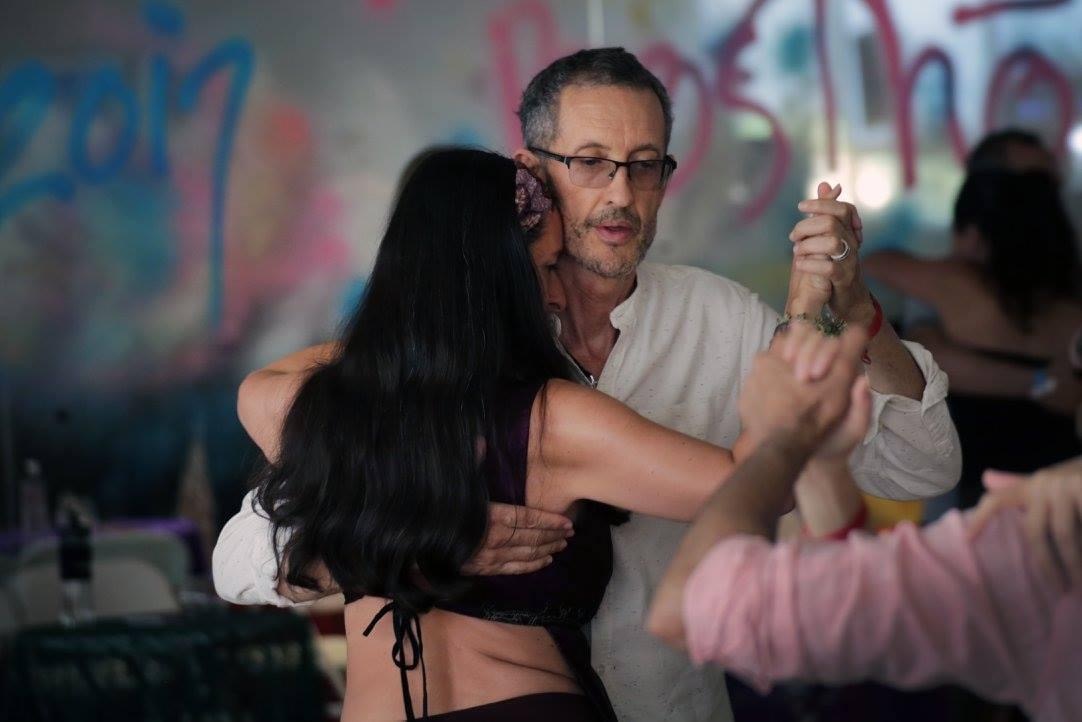
The State of Embrace

Mata Amritanandamayi, known as Amma has hugged more people
than anyone in human history.  She knows something about
the embrace that even tango dancers need to learn.

The embracing saint from India says, "If you can touch people, you can touch the world."

Look carefully at your community.  What is the "embrace"?  Is there one?  Some say close embrace tango is disappearing in Germany, where I presently live.  If it does, then it will return.  The embrace closes naturally between kind people.

One of the problems of close embrace tango is that it has been billed as "social" tango, and that can feel like hypocrisy when antisocial people are teaching or practicing it.  When "social" means "strict

Sunday, July 27, 2014

Tango's Endangered Eco-system

We are the only tribe on this enchanted, "wild" life refuge.
Is what we are doing sustainable?
I love tango.  Don't you?  Sometimes it feels as if there is a tango boom going on.

But not really.

Venues come and go.  People come and go.  The eco-system of tango--upon a closer look--is fragile, and our little tribe does not seem to know it.  I see a milonga like a wonderful wildlife refuge, and we are the inhabitants.  We are the only inhabitants, and although there is a need to bring new life into our refuge, we are not sure if we like new blood.  Our worst enemy is ourselves. We ourselves are the

Friday, July 25, 2014

The Rogue Dancer: Your Problem

Passive-Aggressive Behavior is not to confront
the rogue dancer assertively.

The tango community and the joy of dance belong to everyone.  But then comes along the rogue* dancer who runs into everyone, causing injuries and even causing people to leave the community to find another place to dance or just give up.  The rogue dancer is not the problem!

The problem is being passive-aggressive.  Rogue dancers come and go, but passive-aggressive behaviors stays.   The rogue dancer needs feedback.  The rogue navigator-guide is usually the problem, but safe dancing is the responsibility of everyone.  Also if you end up dancing with a rogue, you are now part of the "rogue team." A partner not only can but must influence the good-but-

Wednesday, July 23, 2014

Dance as if everyone were watching!

Watch very carefully for a child who briefly appears in the below video.


Did you see the child? 

It was the grey-haired kid who threw down two sticks.  He can teach you something.  He is dancing as if everyone were watching, but as a child--out of pure joy!

The very young, no matter their age, dance spontaneously.
Lots of Innate Stuff, but not innocence.

I danced as a kid. Also, I owned a little plastic guitar, and Gail, the girl next door, put her foot through it, angry at my song and dance.   I was way too happy for her, I guess. 

Later in school, I was shy and was afraid to talk in a group all through my school years. In sixth grade, I nearly destroyed the book I had in my hands as I gave a book report in front of the class. I couldn't sing in the choir because I didn't have the talent. The school music teacher told my mother not to waste money on private lessons. (My wise mother told me about the music teacher's bad prognosis only after I became successful studio and performance musician.) How did I ever make it to being a human being without just giving up altogether?  Before puberty:
  • I couldn't speak freely.
  • I couldn't dance freely.
  • I couldn't sing freely.
  • I couldn't play an instrument.

Saturday, July 19, 2014

The Joy of Tango Traffic

Warning:  This explanation of "The Joy of (Tango) Traffic" is NOT for beginners.

Because of floorcraft hand-outs that actually cause more floorcraft problems, I am submitting this floorcraft guide to my readers, hoping for comments to make it better.  Then I will present a printable handout--mostly for the shoebag of the rogue "expert" dancer at your milonga.  It will be a shorter, two-page version.

Let's use what we know about traffic.  Most everyone has some experience with driving or observing drivers.  Having said that... 
What is the most outstanding difference between auto and dancing? 


In four words:  "Tango traffic's a joy."

Los Códicos del Tráfico serve the very same purpose for autos on the road as for rules of floorcraft

Thursday, July 17, 2014

Moment of Conception in Tango

"Stork theories" of how tango babies are made will not help tango survive.
Conception begins in human need.
When were you conceived as a tango dancer?  Can you remember?

My guess is that it was because of social contact. Primal human needs, such as touch, communication, movement, enjoyment, deeply seated courtship behaviors that (should) continue for a lifetime.  One that is very important for many is the desire to feel alive.  Some go to extremes to get this feeling (roller coasters, risk-taking, and also a long list of negative behaviors).  Dance is a socially acceptable way to get many human needs taken care of all at one "Mall of Human Needs."

I was conceived as a tango dancer in a bike shop.  In 2006 I was buying a super-dooper triathlon bike

Sunday, July 13, 2014

The Archetypal Leader in Tango

A continued discussion on leading and following . . .


Archetypal leaders are unique.

In the Jungian sense, the archetypal leader is primal, a single leader whom others emulate. Plato would say the archetypal leader is the "substance of all leaders," and mortal leaders are mere shadows of that substance.

Who is the archetypal leader in tango?  La Música.  In dance classes we talk in very technical, prosaic terms about roles (leader/follower).  The language of art, feeling poetry perhaps must or should put aside in oder to better describe what each person is supposed to do.  We talk about duties of "leadership."   But in trying to be empirical and exact, I believe we have sacrificed the magic, the art and the poetry of tango.  Somehow "leader/follower" become the terms that best describe our magical roles.  I question the poetry of these terms, or even the exactitude of these terms.  If indeed the music is the archetypal one-of-a-kind leader in tango, now we must find

Saturday, July 12, 2014

La Música Dirige, Seis la Tocan


Siento nuestros pechos, que se llenan del aire
Como si fuera el aliento vivo, un dúo de Bandoneones.

La Música Dirije, Seis Tocan 

El bandoneonista toca con tanta pasión,
Me pregunto si movido por el éxtasis o el dolor.
 Él y el guitarrista,
     la violinista,
        el pianista
           y nosotros, dos bailarines,
Somos un sexteto en esta pequeña cantina
En nuestro trance hipnótico colectiva, de cuatro más dos,

Friday, July 11, 2014

Neutered Tango


Don't neuter my tango!
Warning:  This post is rated "VS" for "very sarcastic" and with elements of bizarre humor.  I suggest you read another blog.   Do an Internet search for, "Normal Tango Blogs."  Mine won't come up.  :-)  Or skip to the end, called "Seriously Now" where I return for a moment to my very serious self.

Wednesday, July 9, 2014

Tango is NOT a conversation!

The leader speaks.  You listen.


"Just for a change, shut up and listen, okay?!"

"This is not a conversation.  It is a soliloquy.  I talk you listen, alright?"

Above, I am quoting the archetypal leader, La Música

She (La Música) is really tired of speaking and too many of the dancers not listening or thinking they are not allowed to listen because of their role.  La Música is really, really tired of it.  She'll calm down in a second.  She just having a Richard Wagner moment--a bit out of control.  At some

Friday, July 4, 2014

Wasted time: Musicality Classes for Followers?

A continuing dialogue on the concept of leading and following . . .

If you are a "follower" you may be wasting your money on musicality classes. However, if you are a dual-listener (listening to the leading of La Música's voice and your partner's body), then musicality classes make sense!

"I am following the music.
Listen to the music first, to me second."
I have had women say that it doesn't make sense to take musicality classes "because a woman has to listen to what the man hears in the music." Yes, I can understand why a "follower" would say that because that is what she hears in the word "leader" and what is specifically said by some teachers! However, if

Tuesday, July 1, 2014

Kind tango vs a kind of tango


Social tango is kind tango . . .

. . . not a kind of tango.

More than a few people I have known have left the tango community or commuted to a different place because of anti-social elements--sometimes real, sometimes perceived.   In the outward world, surely we will find kind people who are perceived as arrogant or antisocial, and social people who are truly dangerous, even psychopathic.   Not many people continue dancing over a decade.  So this makes me wonder if I will survive, and if I do, what will I look like?  Will my tango be social?  Will I be still kind and generous?  My steps, but embrace may look like social tango, but will the outward signs of

Sunday, June 29, 2014

Milonga Ohne Worte

Link to the English version: Sacred Silence at the Milonga

This was my first blog post in German (below).  Articles, like this one, will from now on be found on a separate blog: "Tango Therapeut."  My blog features a translator on the right margin.  That helps those who are reading in English as a second language.  I do the same, when I read Spanish, German or French before going back to the original.   If German is a second language for you, as it is for me, you can use the quick translator to read this too!
 
Thanks,  Mark, (a.k.a. the Tango Therapist).


Stell Dir vor: ein Tanzabend ohne zu reden.

Ich muss es mir nicht mehr vorstellen, Ich erlebte es neulich in Heidelberg, Deutschland.

Dieser Beitrag ist KEINE Fiktion, auch wenn er ein wenig surreal erscheint.

Der Tanzpalast Don Carlitos in Eppelheim bei Heidelberg hat eine angenehme, fröhliche Atmosphäre, aber vergangenen Sonntag war es etwas anders. Die Atmosphäre schien verändert, als ich rein kam. Üblicherweise findet die übliche Sonntagsmilonga einmal monatlich statt, aber diese war eine besondere Milonga an einem anderen Sonntag. Eine Rundmail machte deutlich: dort würde nichts zur hören sein als Musik, und davon abgesehen nur Stille. Das mag einige Leute abgeschreckt haben. Umso

Saturday, June 28, 2014

Obsessive/Compulsive Lane Changers


On my way to my first OCLC disorder meeting
I had a dream...  
I went to a meeting for Obsessive Compulsive Lane-changing disorder (OCLC disorder). You see I am obsessed with changing lanes, compulsed to change lanes--a not so rare disorder found at milongas everywhere.

It's my first time ever at the group, and like others before me, I stand and say, "Hi, my name is Mark.  I have OCLC disorder."  I sit down. Others look and me and smile with compassion that finally I can acknowledge my disorder.

I wake up.  Sweating.  Do I really have Obsessive Compulsive Lane Changing disorder?  I don't really believe that is the case, but maybe I

Thursday, June 19, 2014

Tango: Better than Sex?

Yes.

Is there even a question here?  Isn't it obvious?

Human need through normal sexual desire brings children into the world through the power of sexual attraction.

Yet sex is empty by itself.

Tango includes much more than "just sex" can.  Tango is clearly second to the wonderful mixture of a loving partner and a healthy sexual relationship.  ("Healthy" being a relationship that is similar to a healthy human body--a body capable of living on without dying soon and fully of happy hormones.)

As powerful and as wonderful as having a loving relationship, even with the perfect partner, one can lose this partner and

Saturday, June 14, 2014

One Leads, Six Listen

A continued series on the question of who is leading whom                                 en español


The bandoneonista plays with such passion,
I wonder if in ecstasy or pain.
He,
  the guitarist,
     violinist,
        pianist
          and we two dancers--
A sextette, on the pub's tiny floor.
In our collective hypnotic trance, four plus two,
Together we bring to life the dots on paper
Of a composer who wept as he first heard
His tango painted in the air, moving us to dance.
La Música had forced his hand to write.
Now he sees his art brushed with the violin's bow,

Saturday, June 7, 2014

Tango's Trademark Infringement

Ficciones en las Noticias
Lady Justice hears the facts, blind to opinion.
Tango lost in the court of common sense.

(The Unassociated Press)  The World Tango Federation!* recently attempted to patent the terms Leader and Follower.  However, the Unified Patent Court in the European Union has denied this attempt.  Other international patent legal bodies have followed with the UPC's precedence.  Through a patient lawsuit, the Ballroom Association Directorate (BAD), countered the WTF! attempt, and has won the patient for Ballroom teachers worldwide to have proprietary usage of the terms "leader/follower."  Tango teachers around the world have been ordered to stop using "leader and follower" when teaching the roles of tango couples by 2015.

Ballroom Association Directorate (BAD) unequivocally demonstrated that Leading and Following is

Friday, May 30, 2014

The power of the Mirada

A continuing dialogue about leading and following...                          Romanian translation
The eyes are more powerful than the nodding of a head.   

Translated, using tango terminology, the same sentence is:  

"The mirada is more powerful than the cabeceo."

Traditionally tango dancers say that the cabeceo [the nod of the head] is what the man does and the woman, the mirada [the look].  I never understood the concept of these two terms having anything to do with one's gender, and in practice, women nod and men can respond to a woman's inviting smile by coming to her with continued eye contact.  I don't want to be left out of the power of the mirada.  Simple eye contact and nothing else has no second in non-verbal communication.  I want to use the mirada's magical power too!


"Magical power?" 

You think I am kidding, right?  Pediatric developmental research has long indicated the importance of a lot of eye contact with children in order for them to develop normally.  Very negative things happen in our development if our caretakers give us little or no eye contact.  More recently, the New York Times reported on the new "flurry" of research on eye contact.  The lastest new study was from

Sunday, May 4, 2014

Violet tango, or just the blues?


Is tango just a little too depressive?  Too blue?  

I have heard people say this, but I do not think so at all.  It's best to be a little bit more careful with the colors on your palette than to paint tango all blue.   Try violet, for example.  Let me explain:

Tango music can sound upbeat and happy, but then if you learn the meaning of the Spanish lyrics, you can be surprised by how sad they are at times.  Sometime even the music and the lyrics both seem like just a Spanish version of the blues.   Maybe learning Spanish can be hazardous to your emotional well-being?  Well, not really.

I am going suggest a different frame of this picture of sadness or melancholy that may be helpful, but first a story:

Saturday, April 26, 2014

Tango's Two Essential Steps

Since we had little feet we have known
the essential steps of tango
Artist:  Diana Lee

Left

and

Right.

Try it out this weekend! It's easy to remember:  Left and right.

Tango was much more difficult before humans developed the ability to walk on just two feet.  Because of your humanity, tango is the easiest dance to learn in the world.  It takes a lifetime to master, but left and right are pretty easy steps,  ¿sí o no?

I don't mean to brag, but I started doing essential tango steps while even in diapers.  Chances are, you did too.

Two other essential things:

Tuesday, April 8, 2014

Sacred Silence at the Milonga


Link to German Translation


Imagine an evening of tango without any talking?  I do not have to imagine it anymore.  I experienced it last Sunday night in Heidelberg, Germany.

This post is NOT fiction, although it seems a bit surreal.

 Don Carlitos Tanzpalast in Heidelberg, Germany has a pleasant, happy atmosphere.  But it was different on last Sunday evening.  It seemed like the atmospheric pressure changed as I walked in.  The Sunday milonga is usually monthly, but this was a special milonga on a different Sunday than usual.  The email message made it clear that there would be only music and silence.  It scared a few people away perhaps.  All the better.  I was ready for this new experience.

I love the sound of music and people as I get near or enter a milonga.  I express myself in a social setting by enjoying conversation; so I am not against talking! I think there is a "music" to happy people talking.  However, there was a calm from the silence in the milonga's foyer which struck me with a déjà vu.  The nicely decorated room to change one's shoes, strangely reminded me of

Saturday, March 8, 2014

Gender imbalance with 50% men?


The man on the left weights 100 kilos.
The man on the right weighs 70 kilos,
This is a gender-balance teeter-totter. 
Presently I am at an event with 90 men and 90 women--a so-called "encuentro."  Gender balance, right?  Not quite.  I see a lot of women sitting too much, waiting to dance as men sit at the bar or sit with their "tango date."  This is not evil or wrong.  In fact it is great!  Mature dancers who dance with only a few should be "special guests," because they are not really part of the gender balance equation.   We NEED people who sit a lot!  They subsidize our milongas!  No complaints about special guests.  At purposely gender-balanced events, special guest need a VIP seating area so social dancers do not waste time trying to catch their eyes for a tanda.  For the rest of us, one man = one man.  Or is that enough.  I don't think it is!

Presently "gender balance" is a simple addition equation:  One man + one woman = gender balance for tango.  If you prefer the simple one-women-to-one-man-gender-balance equation, then stop reading here.  Really.  Please stop reading here.

For those who prefer to go to an event that requires traveling a long way, wouldn't you prefer having organizers who develop to a better way of determining the participants' social tango I.Q.?

What is your Social Tango I.Q.?  
(Social Tango Individual-Quotient)
Especially men should consider what their social tango I.Q. is.  What do they offer to the community's

Sunday, March 2, 2014

Just let me dance!

ALREADY SITTING TOO LONG?
"Oh, please.  Three teachers
with three songs each?
I could have stayed in bed or
have gone to a Zumba class."**
Watching a tango performance can be inspiring.  I have been deeply moved by a few performances, but mostly they go on too long or do not promote the feeling of a social milonga or small festival.

I am not the only one. Many seem to prefer to suffer in silence rather than challenge what appears to be a majority of adoring tango show watchers.  But what would happen if a show at a festival or an encuentro were offered as an option.  Maybe the majority isn't truly the majority after all.

Wouldn't it be nice if organizers would simply give it a try?  It would be easy:

1. Offer at registration the option for participants to continue dancing in another room rather than go to the performance.

Saturday, February 22, 2014

The Tanda: Your life on fast-forward

The tanda is your life on fast-forward.


The tanda (a set of four songs at a milonga) poetically represents stages of your entire adult life with your partner.  But pay attention!  Your life on Fast-Forward finishes in about 15 minutes.  It goes something like this:


  • In life a common external event brings a couple together.  In life it may be the same country, town, school, neighborhood.
    In tango it is the milonga.
  • In life a second event moves you even closer or something that emotionally moves you both.  Perhaps it is a class that interests you both.  In life this is being in the right place and the right time, a sparking of one of countless important coincidences in the Universe every millisecond.
    In tango, it is the music that leads people together, to connect, to move in tandem, to stop

Sunday, February 16, 2014

Social Tango is an Invitation-Only Event

     The Church Social is a Members-Only Club
Sound like Tango at times?

There's a difference between social tango, in which everyone is invited, and on the other hand, an event that should be best called a tango social in which only the guests know about the event. 

"Encuentros" are in fact tango socials and not social tango.  Let me explain.

Women's Group Church Socials don't invite men and non-members. Such invitational events are called "socials" in English. Much of their advertising is word-of-mouth. In the same way, encuentros may need to advertise at first, but once they get going, I believe they should stop advertising and stop having many connected to the event on social media.  Encuentros today often have more that are turned away than those who are invited.  This unnecessarily causes too many hurt feelings.  For example, if you are in fourth grade you don't tell everyone in your class that you are having a big party, and then hand out invitations to half the class, right?  Also, the wise party organizer who is putting on the party (encuentro), should realize that local and very good close-embrace dancers will be upset that right there in their town is a wonderful event, and they are not invited. The list of haves and have-nots is clear because many are allowed to join the social media page to see those who are coming to the event.  It all needs to be fairly discrete, even secret or at least not flaunted.

Encuentros are havens for close-embrace enthusiasts. I am one of those enthusiasts!  And I agree these events can be wonderful, but they are not, as often advertised, "social tango."  There is no right or wrong between the two, but social tango is much different than a tango social--an encuentro.  Sure, we are social in our little closed group.  But let's be discrete (social) with those who did not get in for whatever reason.

The Private Party Milonga
Last summer, my partner and I were invited to a wonderful secret encounter in the middle of a Bavarian forest!  The dance floor was put together only for one night each year and it fits only on one place on earth with a tree "growing" in the middle.  Magical! This secret milonga was absolutely private and a celebration among around 40 friends.  My partner and I knew only the organizers, our friends. We were privileged, lucky and chosen.  Exclusive milongas/invitation-only events have their place among close friends and word of mouth.

I have been invited to encuentros in Germany, Austria, France, Italy, Spain, and Switzerland. If only I were rich!  I'll admit it:  I love encuentros, and they are not evil or wrong.  But let's be truthful. They are not social tango either; they are tango socials--exclusive, invitational-only events.  At their very best, encuentros are like the secret milonga I mentioned above. No pictures could be shared on the Internet, no deadline to enter was present, and we were asked not to mention it to others to avoid hurt feelings. That is presently very un-encuentro-like, but I feel that would be a good standard.  Word of mouth is a good advertising mechanism.

I do not feel social when I am invited or admitted into an encuentro.

When I have been invited, I feel privileged.

When I am not invited, I feel excluded.

When I get my name in soon enough, I feel relieved.

When I know that an organizer "squeezes" me in after the deadline, I feel grateful.

When I know I could be like many other people who are outside the door wishing they too could enter, I feel lucky.

But not social.


So I admit it.  I like encuentros (tango socials) but my heart is with social tango, a tango that is warm, kind and accessible--even to the uninvited.  Social tango is the only way tango will survive.  The paradox is that, the only way that I will survive in tango is by having events that have all the events that one finds at an encuentro.  I have to live with that paradox. 


Photo Credit:  https://www.christianpost.com/news/12-signs-of-mediocrity-in-a-church.html


Thursday, February 13, 2014

Tai Tango Chi

Chi is my partner; she dances me.
Describing the world of Tai Chi and Qigong in the martial arts,  Garri Garripoli says in his book:

The "master. . . moves as if entranced in a tango with the Universe."* 

And the converse is true, paired tango dancers move as if connected to the soul of the one before them and the universe.

I have a theory:  Tango is best not an analogy to describe martial arts, as Garripoli and others have done.  Tango is at its best a better expression of yin and yang than the martial arts!  The dancers harmonize and connect their energy-centers and melt together as one.  The martial arts do this, but less.

Saturday, February 8, 2014

Stop Practicing Tango!

When one of the greatest cellists of all time, Pablo Casals, was asked why he continued to practice the cello three hours a day, he replied, “I’m beginning to notice some improvement.”  He was 93 years old.

Give up practising tango--at least in the sense of it as an act of preparation.

The word "practise" comes from Greek (praxis):  

Saturday, January 25, 2014

The Embrace: Learning-by-Being

The vintage embrace comes from being not doing:
Being there over time.
The tango embrace is the first step we learn in tango, but usually not from a teacher.

The embraced is learned from being not doing!

Thursday, January 23, 2014

R.I.P. Tango: 1983-2033

The one who believes she'll live forever, takes the biggest risks.
The Body Tango is us.  I'll call her, Señorita Tango, but she is us.  The Body Tango says to itself, "I live forever!"

Denial of mortality is rather normal, I suppose.  But let me guess, perhaps by the year 2033 Señorita Tango will succumb to a slow death.   Could it be that soon?

Wednesday, January 1, 2014

2014: Resolve or Dissolve?


Photo
The Now is when we have good eye contact with the Universe

If tango is just a dance, a sport, a diversion, even a way to feel alive for the moment... then you have not yet danced the dance of dances, life's dance.  Tango allows us to touch the hem of the divine, all the while, feeling fully human and embodied as a woman or as a man.

Sunday, November 10, 2013

The Hierarchy of Tango Needs

How does a tanguero or tanguera define basic survival and beyond?
                      Only if Abraham Maslow had known tangueras!
                      His Hierarchy  would be much different.

Maybe it is different from Abraham Maslow and many others who don't know what tangueras and tangueros know!  Below is the survival list I have learned from tangueras: it includes air, water, food, shelter, and sleep--and much more!  Modern psychology, even with the latest "truth" in empirical psychology, Attachment Theory and it corresponding typical negativity, "Attachment Disorder," really only poke at what it that we all need throughout life.  (See discussion following the poem below.)

Monday, November 4, 2013

Men: It's time for your "Coming Out"!

The closet of you inner child has to be
sound proof not to dance
By accident, I came across a man's sincere question on "Yahoo Answers":

"Why do so many women like to dance? What is so fun about it? ... Every answer I have found is, "It's fun." Well why is it fun? I am not trying to cut down dance in any way and am not being macho. I just want to understand why so many women like dancing .... In my experience few men like to dance.

"If someone can present me with statistics to the contrary, I will be happy to take back my remarks on the issue.... I am taking a dance class and embarrass myself there every time I attend. I know what it feels like to look like a fool..."

-------//-------

Please stop here and think about how would answer the man (Bucky) in a few sentences on a piece of paper.

Sunday, October 6, 2013

Tango's Musical Terms: The Essential Elements of Music

Music's Essential Elements:  Melody, Harmony and Rhythm.  

If tango dancers really wish to dance musically, they must at least sense which of the three elements of music is the fundamental block.  I realize that there are many more elements (see link at the bottom), but let's keep this discussion on what is the essential of the essential.  Among these three blocks, even the focus is often questionable. which is the one essential one?  Are they all essential?  No. However, if you watch the camera man's focus on music performance, the limelight is often on the melody.  Also, much discussion on the Internet on the essential blocks starts with the melody.  It's true in tango that I often dance the melodic line, but the best musicians who play/sing the melodic line are exceptionally connected to where the rhythm is!  Are you?

Monday, August 19, 2013

The Pause of Time


A Century in the Pause of Time

I want to be early this time to the milonga.
Seems that I fight time in this world.
Silent time is my enemy, a struggle not to be late.
But when music-time starts, the clock stops for me.
And in the Pause of Time, a new dimension enters.

Friday, July 26, 2013

Black Belt in Tango?

The Innovator:
Starting, not "starting over."

I am trying to earn my white belt in tango.  Please join me and many others -- those of us who are on a wonderful path of tandem self-discovery in a dance called tango.  

How often have I heard someone lament after starting with a new teacher that they must "start all over"? That's nothing to lament about! Starting from the beginning each time is the task at hand in tango and in life!

Monday, July 15, 2013

Tangueras: Don't get into that cab!

A super man asks for a dance
non-verbally with a nod or wink.
It's called a "cabeceo."
Struggling with Spanish and English terms that are easily confused?

Well, here are two terms that tangueras and tangeros easy get confused:

Cabby CEO  from cabby [cab driver] and "chief executive officer."

and

Cabeceo  from the word "cabeza."


Cabeceo:  This is Spanish for a nod of the head -- a non-verbal way to get a nice ride around the dance floor to locations of musical bliss one desires to visit.

Cabby CEO:  This is English for a high risk driver running his own business at any cost.  A cabby CEO's business is to talk you into going to locations he (or she) is going.   It is easy to detect cabby CEO's:  They are very verbal taxi drivers (or tango dancers) who ask if you want to go where they happen to be going. (They won't be interested where you want to go; that is why they asked.)
 
Hey, wanna dance?
I drive you mad for good price.*

*Warning: Never take a ride from someone who suggests a ride by stopping you to ask.  The destination may be dangerous.  Don't lie.  Just say, "No thanks."  More on tango etiquette here.

Yes, you there.  Let's dance!
Ladies:  Don't leave it up to the man.

One can be non-verbal and get dances very assertively.  This photo is my favorite example of a female "mirada" (look) -- the ladys' version of a non-verbal request for a dance.  My guess is that she got that dance.

I suggest a little bit less assertiveness than this, but she's on the right track.


Photo credits:
Super cabeceo
Cabby CEO
Female cabeceo (thanks Christian Xell -- a poster for a milonga in Vienna, Austria.)

Tuesday, July 2, 2013

Why Real Men Don't Dance

 
When I was a boy

When I was a boy,
I was told not to cry.
So I stopped.

When I was a youth,
I was told not to sing.
So I stopped.

When I was a teen.
I was told not to dance.
So I stopped.

When I went off to war,
I was told not to talk.
So I stopped.

One day she asked me to dance,
And I have learned to cry,
I have learned to sing and talk.
I am now a real boy,
Working on being a real man.


This poem is dedicated to the hundreds of soldiers I have met as a therapist who have started talking again after being afraid to tell their story.  It is an honor to meet the real boys and girls in my office.  They do not know me as the "tango therapist," but, as you might imagine, I do tell them to also learn to dance along with learning to talk.

Discussion:
A friend asked me after my last post on the body as the primal musical instrument if each person has at least a latent ability to dance.  I answered her in the words below, and then was inspired to write the above poem.

"Not every person weeps, but doing so is uniquely human.  Not every human being can talk, but that is uniquely human.  Not everyone can sing, but that is uniquely human.  Not everyone dances to music, but that is uniquely human.  Sometimes we teach each other not to be human; otherwise, we would do these things naturally."

Sunday, June 30, 2013

The body as the first musical instrument

Picasso Ceramic:  Dancing to the flute
Through tango I have discovered that the most primal musical instrument on earth is the human body.  Each body contains its own rhythm, called a pulse, and internal music.  Of course, many will dispute this, but it was the acceptable theory during one of the most amazing periods of artistic human development:  The Renaissance.  The power of musica instumentalis is that an orchestra or musician can give two or more people a common pulse.

I love this ceramic piece from Picasso (shown to the left) because it shows the power of musical expression to make the animal within us dance.  Only the child human animal dances without instruction to music; so what looks like a goat is actually our unique brain delighted by music so much that we human beings are moved to dance.  The flutist and the dancer are one.

I found this ceramic Picasso work of art because recently I remembered something important about my first instrument (other than my body).  I was looking for a picture of a plastic flute I had in fourth grade.  As a fourth grader, I had to learn to play the flutophone.  Before a big concert, all three classes at my school came together and we were playing together.  It sounded pretty darn good, I thought.  But then the music teacher asked everyone who took the music test and got a 80% or above to play.  Most of us put our instruments to our side and just listened.
Flutophone

It was amazing!  What a difference between muddled music and a clean rhythm and clear melody!  This was a huge realization of what musicality is -- it is clean rhythms and clear (even if dark or raspy) tones.

I was not good as a flutist, so I was one of the many who only listened.  But the music became a part of me.  This experience resounded in me.  I wanted to be a part of it.  That is what music does:  It has the power to move us psychologically and bodily.

I eventually dedicated myself to being a musician in fifth grade after hearing a cellist play for the first time. I was so moved that I had to learn to be a musician.  I played later in string orchestras as a bassist.  A year later in fifth-grade summer school, I started as a percussionist, which became my main instrument as a musician in symphonic orchestras, jazz bands and combos.  The electric bass brought me to dancing salsa, learning latin percussion, and then I discovered the most amazing instrument through tango:  The body.

Now I am more musically aware than ever since I learned, through tango, to embody music, that is, use my body as my primary instrument.  My music is movement as a body-musician.  Body-musicians (like singers*) use their body to create musical expression with instrumentalists or as soloists.  Tango body-musicians join with tango orchestras, usually in duets on a floor of many duets of body-musicians, which is called in tango a "milonga."

If anyone asks you if you play an instrument, the answer for tango dancers is:  "Yes.  My body."


*Theories of musica humana did not consider the voice as part of the body but instead musica instrumentalis.  I like this idea that the voice is a separate instrument from the body, but music departments and even my musicians' union when I was a professional did not allow singers in to the union because of the belief that the voice was not an instrument.  During the Renaissance the belief was that the voice box was a separate instrument and was not musica humana: "Musica quae in quibusdam constituta est instrumentis (sounds made by singers and instrumentalists)." An easy way to settle this philosophical hair-splitting is simply to allow the body to be an instrument!  The body includes the voice box, a pounding heart, vibrations of multiple organs, the buzzing and frequencies of molecules and atoms.  When we move our mind begins making its own music.  Therefore, I believe that dancing and singing are examples of how we, especially when aware, become body-musicians.


Photo credit of Picasso's work:
Ceramic:  http://www.rogallery.com/Picasso/Plates/picasso-flute_player.html

Friday, June 21, 2013

Embracing your Imperfection

Tango is a great laboratory for self-discovery.  
Dancing brings out my feelings and insights into myself like no other activity I have known.

Below I have a video clip for you that put some great insights together, a lecture called the "Space between self-esteem and self-compassion" by Dr. Kristin Neff.

From her insights, I realized that the best efforts of educators and therapists have created a world that has less compassion for self and others.  Each year measures of  "self-esteem" rise, but this has become another word for "over-rating oneself."  Perhaps in the misguided world of trying to being special, according to Dr. Neff, we have even created bullies--the need of some people to be better and "extra-special"-- when not merited.

In talking with others about this concept, a visual idea came to mind that you can apply to your dancing or any aspect of your life.  Dr. Neff talks about three elements being in balance:  self-kindness, our acknowledgement of our part in humanity's universal imperfection, and finally, self-esteem.  Please watch the video, but I think this graphic (below) will help you understand the profundity of her ideas:

First look at the bottom of the graph, which describes the bell curve of our shared humanity (that we are all imperfect to some degree).  Using dance as an example, being "too compassionate" with yourself will keep you from getting better, and feeling too much self-esteem keeps you from being present with your partner as you think too much about yourself and being great--especially in tango, a social and partner-centered dance.  The bell curve is a centered "fulcrum":  A mix of knowing your talents and being at ease with your limitations.  Each person is different, but that balance is essential for each of us.*

The top line, balancing on the top of humanity's shared imperfection, is the balancing rod of self-compassion and self-esteem.  If "the space between" is equidistant between self-compassion and self-esteem, the person will be balanced and happier about their expression of tango (or any other subject).

I work at being kind to myself.  I think these ideas (expanded below in the talk by Dr. Neff) have deep meaning for anyone who thinks they have pretty good self-esteem, but are also not very kind to themselves.  That's me.  Being kind to others seems much easier.  But, I realize now something is out of balance, and it is not just me.  I think many around me struggle with this same imbalance.  Perhaps, humanity's imbalance is even the center of our imperfection?

Maybe you didn't need to hear this message, but I did:


How is your dancing?   How is your "space between" self-compassion and self-esteem?  Starting with my first class in tango, I wished now that I just worked on being advanced in "being kind to oneself."  Then self-esteem can truly be because of merit.  Also, I must admit that my self-esteem may have been unmerited, especially as a young musician, as I secretly dealt with my self-doubts.  On a deeper philosophical and spiritual level, self-esteem is very much like the cheap-grace spiritual movement, such as the bully who believes he is going to heaven but is cruel to others.  Or on a more personal level, my own self-kindness in certain areas of my life, I now realize, has had to work overtime to cover over the sins of unmerited self-esteem.

What class are you in for being kind to yourself and others?  Advanced?  Intermediate?  I am glad to be a beginner.  That's better than not even knowing that I needed to start!


*The bizarre bell curve:  The unusual thing about the bell curve that I am proposing out of Dr Neff’s inspiration is that we usually do not think of being at the top of the bell curve as being desirable.  However, in the illustrated graph above, it is extremely important to aspire to the “summit” of the bell curve.  To demonstrate this concept, take the story of Buddha or Jesus or whomever you see as being an "enlightened one."  The story of Buddha is that he was protected as a prince from knowing the depravity of human existence.  Once he became aware, his shock and empathy took him to the bottom his psychological life.  Is not the "space between" a middle point where great people go to help others?  In Buddhism another term for this is “the Middle Way.”  The middle point is the place that suffering people go to receive help, and where privileged people go to help from their strengths.  Jesus’ story is one of a perfect man preaching among sinners and healing the sick.  He also touched the very bottom of human existence by being tortured for being seditious.  His teachings such as “love your enemies” still are seditious—even in the very Church he founded.  The Word becoming flesh is also a middle point.  It must be a great disappointment to inspired teachers that their followers seem to try to find the far right end of the bell curve and look back at humanity with their own hard-earned self-esteem.


Therapist: Thanks for sharing this with us. Your "beginners mind" helps me and I think it will help many.

Comment or "like" Tango Therapist's Facebook page at this link
or


Saturday, May 25, 2013

The Grace of Embrace


Image and Likeness of Grace


I once tried to understand religious grace.
I watched the cruel ones claim salvation's grace.
The cruel bully at work, proclaims his salvation:
"Not by works, but by grace we are saved,"
He announces--in all of his proud gracefullness.

I find heavenly moments at the milonga.
A refuge from the the cruelties of the world.
I ponder how a dancer embodies grace --
Its essence, not given but striven for.
Do not angels work on their grace of flight?

The Grace of Embrace is my heaven on earth.
Its warmth is the likeness of celestial grace,
Movement in tandem with the divine.
It is not Soul alone who embraces me
But dual grace, a duet, a harmony of two.

Spirit's grace stays on axis when I wobble.
She doesn't leave me when I stumble.
She directs the heavenly choir of dead musicians,
Beating out canyenge rhythms on my soul.
This is truly Amazing Grace.


Photo Credit:
http://www.tumblr.com/tagged/martha%20graham 
Artistic notes:
Martha Grahm would not have been caught in a tutu, but I liked the photo. 

Post Script:
Before I was the "tango therapist," at work I would send out a few friends messages of "tango theology."  So this is another part of me -- the Tango Thelogian: 


Notes on Tango Theology:
Christian theology, the idea of God's grace is that it is
an unmerited gift of God, from a letter written by St. Paul.  Ephesians 2:8:   "For by grace you have been saved through faith, and that not of yourselves; it is the gift of God, not of works, lest anyone should boast. .  I do not think Paul is saying this in the way that it has been misused over the centuries.  The context is talking about "works" and the discussion is that the new believers had to be circumsized  -- good that he cleared up the issue of "works."  That would have been a bloody problem.  James 2:18 addressed the misuses written after St Paul:  "But someone will say, “You have faith, and I have works.” Show me your faith without your works, and I will show you my faith by my works."  Grace is not given even though not unmerited!

So my definition, as I have learned from tango's help is this --
Grace:  An awakening to our merited divine beauty.  Divine grace and the grace of a dancer are expression of the same thing:  Elegance and refinement and movement before and with God and her creation."  Don't look for this definition in any dictionary.