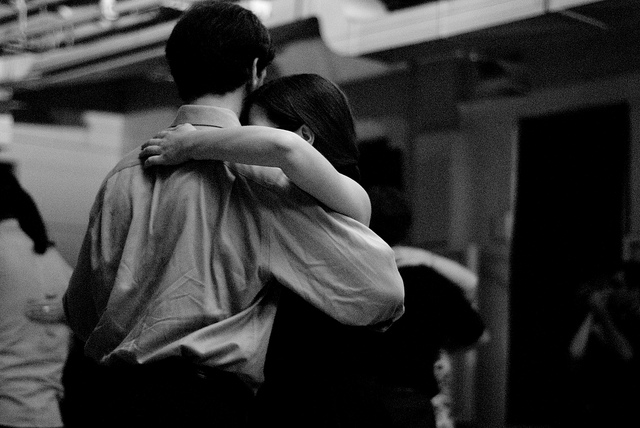
I am addicted to air. I try not to breathe but I just cannot seem to stop. I am addicted to tango. She and I synchronize our breathing. We find a breath that defines the music as us. This breathing addiction consumes me.
I am addicted to water. I can go for about a day, but I give up. I am addicted to tango. The fluidity of movement washes over my soul. I feel like I am truly alive and this fluidity purifies me. My addiction to fluidity of motion consumes me.
I am addicted to food. I can go without food during a fast, but I become weak. I am addicted to tango. The community of tangueros and tangueras nourishes me. I realize how much I am hungry for connection. My tango-fast cannot last. I am am addicted.
I am addicted to shelter. I try to be out in the open and rely just on myself, But I become cold and wet or too hot, and give up my quest. I am addicted to tango. The world pelts me with cold rain or I wilt under its stress. I try to be just myself, but I find myself once again seeking shelter In her embrace. I admit it -- pure addiction.
The embrace is my air -- call it an obsession if you wish. The musical fluidity of movement is my water, truly my weakness. The community of dancers my nourishment -- my addiction, I guess. Tango's gestalt is my fortress, in the great hall we dance. I am addicted, you might say...
But I say I am surviving life -- if joy be "survival." Join me in my "addiction." Come get your fix.
When I am present, I feel a transfer of information. More than just a transfer, I feel an understanding, an empathy. But it's only when I am present. Listening.
I have experienced this myself, but it has been validated in movement therapy (tango therapy). When I was working with a combat veteran and his wife, using the therapy protocol I am developing. We worked on two psychological traumas. One was with his father's abuse and the other nearly dying in combat. In the first case, she felt the hatred leave his body. "His body vibrated, and I knew that he had forgiven him," she said. Immediately he felt sorry for his father who never got to know three grandchildren and his amazing wife. In the combat trauma resolution, he felt that his wife fully understood his experience. That is what many vets NEVER feel -- they do not feel anyone could understand them, especially their partners.
I feel this transfer of information only when I am listening for it. It makes sense, right? If someone is talking to you, and you are not listening, what do you hear? Even if you half-way hear what they are saying, there will be misunderstandings. So try listening. I find it easy to forget to listen. So I practice! Non-auditory communication is an art, whether it is in "listening" for visual body communication or "listening" through the embrace.
Let me give you an important personal example: A while ago when I got a new job, I organized a farewell luncheon at a salsa lounge, which provided a fajita buffet for us. A semi-professional dance friend of mine came and taught my colleagues how to salsa, and we demonstrated a tango, a vals and a milonga. After eating, I danced with many colleagues, but when nearly everyone was gone, I got a chance to dance with a person at work whom I did not trust -- a chance to dance with the enemy. My work colleague was once a dance instructor. We had endured a long difficult relationship, but after everyone had left and I was about to get in my car to leave on a 3-day drive to my new job, she suggested we dance a salsa. I suggested a tango. We danced well, although she had never danced tango.
The dance was very healing for me -- I think for both of us. Dancing with her had a lasting effect on me because much was forgiven through our embrace. It was as if I knew how she felt. Immediately I felt an enemy had been destroyed through mutual compassion.
I cannot speak for her, but for me a lot of animosity melted at that moment.
Some say that tango is only a dance. It can be much more.
Photo credit: Eddie Arrossi, photographer and tanguero, Washington, DC
Ladies, you will need technique classes to wear these.
But why would you?
How important is technique? As Dieter, a tango teacher in Germany once said, "In Tango, Technik ist alles. Alles!" We would never say technique is everything for art or for making love, and so such a statement does not work in tango either. The technique-is-everything notion is doubly erroneous for tango. Isn't tango a combination of art and making love?
Maybe the question about technique's importance should not be how but rather why:
So why is technique important? Technique as expressed in ballet and stage tango is for the wrong reasons and is a dead end. Technique, I believe, is a way to enjoy our art throughout our lives. Sure, without technique, a dancer or any artist becomes limited in their own expression, but if given a choice, I am in favor of bad technique over a lack of artistic expression or passion for the divine spark within one's partner.
Before the technique nuts hunt me down, torture me with high-flying boleos and gancho me to death, hear my story:
As a musician I was a technique nut. My teacher was a technique nut. Ron Falter was a clinician for Ludwig Drum company, and he would go all over the country giving drum clinics on technique. So I was his disciple -- probably his most devoted disciple. We were like Gnostic musicians, he and I. The only portal into the Truth of Music was through technique.
The end of Gnostic-Musicianship
As a young teen, I was always hanging out on the university campus where I took music lessons. One day, I walked into the University band room, and a cohort musician, Brian, was there playing very well with the varsity University Jazz Band. I realized something at that moment. His teacher was a learn-by-doing teacher. Technique was secondary to playing a lot. This was the moment of my musical enlightenment, my epiphany. I was no longer a technique Gnostic. I slowly broke away from my teacher. I played with a lot of musicians. That is where I really learned to be a musician and not a technician.
I moved to San Francisco, and joined the Eddie Money Band. Everyone in Eddie's band took lessons. It was the assumption. At the time, I thought I had graduated from music lessons; so this was an important moment in the art school of life -- always have a coach. Eddie's outgoing drummer recommended Chuck Brown, who was the most renowned teacher in the Bay Area. But Chuck Brown seemed to be more of a technique freak than my first music guru. However, since Chuck was sought out by famous drummers, I was resigned to believe technique-Gnosticism was a fact of life.
However, unlike all the other students I knew, Chuck Brown did not have me focusing on technique so long. I am not sure why. His technique was remarkably different than Ron Falter's. I was not eclectic. I fully learned to devote myself to play with Chuck's powerful method. But soon we went on to other things in fusion and jazz music. Along the way, however I learned something about technique that I had never realized: It is not to play faster or be more awesome; technique is to help with endurance and avoid injury. I remembered that the drummer who had recommended Chuck Brown to me had told me said that he would have had to give up playing had he not learned Chuck's technique. This was the essential lesson on technique!
Technique was indeed essential, but why!? What I learned about music from him transformed the way I played. I believe that Chuck Brown's influence may have made me the close embrace tanguero that I am. Before Chuck Brown, I had double basses, flipped my sticks high into the air. I had seven tom-toms and 6 cymbals. I was a show drummer from a show-drummer gambling casino town. After my lessons with him, I most often was playing on a small drum set -- both in size and the number of drums. Through technique, I had a large sound but on small drums. My transformation was towards music and less towards show, and I no longer had back pain. I played powerfully, without pain and with endurance.
I still have the show-drummer in me. And I sometimes feel like a racehorse inside of the milonguero outward covering. But being "tasty" and going small takes discipline and a reverence for the music. From Chuck, I learned that no note (or step) should be taken without it being essential. Count Basie would say, "It is not what you play, man; it's what you don't play."
To a ballerina who has become a great tango dancer, she would define technique and "bad" technique differently than someone with no ballet background. She gets her accolades from the moves most unlike tango and most like ballet and gymnastics. But remember that as gymnast or a ballerina she must retire early because she will be broken by her technique for show. The toe shoes must come off. To me, tango is about life-long artistry and social connection, not about being awesome while you are young and able.
I learned that technique life long artistry until we die from Chuck Brown. But even if technique helps us to preserve ourselves, that is not everything either! Art and passion and making love always come first to the milonguero.
Sure, I have the highest value for technique. But I am fully aware that "Technik ist nicht alles. Nicht Alles!"
Photo credit for ballet tango stilletos -- yes ladies these shoes are for sale. Buy them here but wear them only at home or over at his place. NEVER walk in them, okay? ;-)
The word tango, like he word milonga, can mean several things. Tango once meant a drum or a place where blacks would meet and dance to the drum beat. Tango is still that. But where are the percussionists now? Every instrument in tango is used as a percussion instrument. Name one that is not!
Okay, give up? Every instrument is used at times in a tango orchestra to slap out a rhythm. The string section tends to use the handle or back of their bow to do it. Everyone else uses their hands except the pianist to tap on their instruments. The piano itself is, of course, a percussion instrument because the strings are struck with hammers. That accounts for all the percussionists, right? No!
There are some percussionists who are often not recognized in the orchestra:
You are that percussionist in the tango orchestra! A dancer is a percussionist, and the floor and partner is his or her instrument. I do not mean this in a poetic way. This is literally true. Anyone striking any object to create or play along with music is a percussionist.
I invite you to stop dancing and join the tango orchestra as a musician!
A good place to start is to stop taking classes on musicality -- well, not quite. How about at least thinking about these classes as musicianship classes? Musicality classes are for people who are trying to understand music as outsiders. How about being a musician? Be an insider -- a musician, not a dancer hoping to understand music from the outside!
Musicianship is not for advanced dancers. It is for everyone, because in reality you and I are not "just" dancers if we are tangueros/-as. I think it is too easy to be a sloppy musician if we do not really join the band. Don't leave it up to the pianist or bandoneónista to be musical! It's your job too! That is, it's your job to be musical if you have dedicated yourself to join the orchestra as a tango percussionist. Maybe it is not a conscious thing, but I think the best social dancers are percussionists.
As a jazz drummer, I played many different objects with both feet and hands (see the photo above). As a tanguero, I use only my feet and legs. I sweep (barridas), make grace notes (toe taps), and establish clear rhythms in synchronization to the music. Besides the floor, there is my tanguera. She bushes me, taps the side of my foot, scadas me, ganchos me. We are the cello and violin playing each other. As instruments of music, I am hers and she in mine as living, breathing instruments.
When I embrace another tango percussionist on the dance floor (a tanguera), I hope our goal will be to join the orchestra as musicians and not as dancers. Anyone can get up and move, but can we embody the music as musicians? I imagine that she and I have joined the orchestra as percussionists in the orquesta que no es típica. The floor is our percussion instrument. We do not dance to the music, we play in the orchestra.
Won't you join the orchestra? When we all join the orchestra, we become the community tango orchestra. All the milonga spirits -- African diaspora slave musicians, European immigrant tango musicians and composers -- will be smiling. If you have joined the orchestra, then you have come home to what tango started as. Tango is a drum. Be a tango percussionist and join the orchestra.
Next blog: As tango percussionists, we will explore why "percussion" technique has nothing to do with how good you look or how awesome you play.
Also planned: Legato percussion -- tango percussion plays with and stretches time one moment and establishes the beat at another. This is what I call "time keeping" vs "lyrical percussion." It is important to know when to make these transitions within a song. And it is easy. It is not just the woman's job to be lyrical or the man's job to be the time keeper.
“People usually consider walking on water or in thin air a miracle. But I think the real miracle is not to walk either on water or in thin air, but to walk on earth. Every day we are engaged in a miracle which we don't even recognize: a blue sky, white clouds, green leaves, the black, curious eyes of a child -- our own two eyes. All is a miracle.” ― Thich Nhat Hanh
The vals played. I always wonder what makes the vals feel so divine. She snuggled up. A familiar embrace. I felt a difference. We danced. The first song ended. I usually do not talk much between songs, but I asked, "Something is on your mind," I can feel it in your body.
"My good friend died in a car wreck."
"Oh no! I am so sorry to hear that."
"And we were in an argument before she died. . . . I feel terrible . . . . and I wish I could have told her that I loved her before she died. I keep having nightmares about her." She paused and then began to cry.
"Did you know her family?" I asked.
"Yes, very well. We lived near each other. They are like second parents to me."
We danced again. I held her now in a different way. I danced in the simplest way I knew possible and embodied the music. She cried in my arms.
The vals stopped.
"How well do you know her character?"
"She was like a sister."
"Then you know what her character would say to you now, is that right?"
"She would say that she loves me, and to go on with my life."
"Can you do that?"
"I don't know."
We danced again. I held her again, leaving room for her friend's character to speak with her. Her balance was sometimes a bit off, although that never happens with her. I knew she was having a conversation. The music stopped.
"Can you do what you know she is asking you to do -- to love her and go on with your life?"
"Yes."
"I suggest you pray for her parents. It's harder for them than for you, I think."
"I know it is hard for them. But you know I am an atheist."
"Of course I know that. But that is the best prayer. If you ask that God to be with her parents, God will hear your pray perhaps more than anyone who is a believer."
"How's that?"
"Because I have an idea that God tires of having so many friends who want his riches and eternal life. God might feel like the rich kid on the block. Everyone loves him because they want something from him. If you don't want these things, I think your prayer goes on top of the pile to be answered. Your friend would like this too."
"Yes, she would."
We danced.
This time I held her and a certain energy went between us. I cannot explain it. But I have an idea that her prayer had a lot of power that night. No adoration. No riches. No request for eternal life as a special favor for believing in God's holy Awesomeness. Just "be with her parents, God, will you?"
And I said the atheist prayer too: "No special bargains, God. Be with these bereaved parents! Be with my friend! And if you won't be, I will be with them in my heart . . . because this is the way you made me and put room in my heart."
Cortina.
Afterword: Events and details are changed to protect the identity of this person and her grief. I cannot tell you if the parents felt God's presence, but the nightmares stopped.
The miracle is the embrace, the music, and the walk that embodies the music. If these do not lead to peace and the miracle of life, I am not dancing tango. Thich Naht Hanh said it so well. Tangueros and tangueras know of the miracle and joy of life better than many.
This story appears today on Veterans' Day for a special reason. The person who died was a young veteran. The risk of death and serious injury of veterans is 10 times the risk than in a combat zone during the first six months after they return. The price of war is far greater than what the general public knows. And if we did know, I believe we would all be fierce Warriors for Peace.
J.S. Bach: Handing over a minuet to Francisco Canaro
to add the cruzado (cross rhythm). See the smirk on his face?
Today's musicality workshop is on the vals. It will take some concentration, unlike many blog posts aiming for an easy reading experience. If you are serious about musicality, then stick with me. Go slow. It will be worth it. Dancing the cross rhythm is like flying, and partners will love it.
Our goal in this workshop is to improve our ability to improvise away from the pulse in three, and understand the African cross rhythm (cruzado also, called criollo) that makes the tango waltz so unique and fun for dancers. Important: Many people already briefly dance the crossrhythm, and I hope this workshop will expand your ability to dance longer in this crossrhythm feeling.
History: Thanks to Francisco Canaro, the expansion of the modern milonga includes both the valscriollo and the milonga. These "criollo" influences came from Peruvian, indigenous, and African influences in the music of South America. Few dance teachers are aware of what these influences are. As a result, we have whitewashed these African influences out of the music. The true vals criollo is not to be heard in many vals tandas at milongas, but even if the vals is clearly a Viennese waltz, one still can use the concepts we are covering here. OTV and Canaro are your best sources for the valscruzado. Let's get into it.
A waltz or "vals" in Spanish has 3 beats per phrase, right?
Well, that is the smallest view of what the vals is.
Six beats better describes the vals crillo.
If we were to compare vals to a language, then a word is 3 beats, a phrase is 6 and a sentence is 12 beats. Just like in language, when you first went to school and learned about words, phrases, sentences and paragraphs, you were already practicing these things without knowing what they were. Similarly, you may be doing very complex steps in your vals, but perhaps it will be helpful now that you are more advanced to understand more about what you are doing. The more long-range goal is for tango dancers to construct poems and short stories that delight their partners via knowing musical phrasing. Followers can also influence this feeling; so it is not information for leaders.
Before getting into all the details, I want you to dance the melody (this is called musicality) of even a vals, something that I rarely see on the dancefloor. After the melody in the below vals, you will hear a very clear cruzado rhythm. Dance on this clear rhythm. If you don't get it, just keep listening. Feel it in your body as a child does. I see people hiding behind cool figures and endless turns to hide the fact that they are just pounding out the downbeat of the vals. So dance by yourself. Feel the cruzado before we break it down and expand your future use on the dancefloor. This is by OTV.
The European Example The vals cruzado is a waltz within a waltz from Africa (3 beats against six), but Europe had a similar phenomenon that did not make it to Argentina: The Baroque dance and music (below) is also in danced in six-beat phrases. In the following example, if one thinks in 6, notice what happens on 2 and 6! This is a common form of Baroque dancing in which dancers bob down on the beats 2 and 6 of each phrase--clear six-beat phrases!
As I mentioned earlier, if you count in six, they are bobbing slightly down on 2 and 6. That is the typical cross rhythm of their dance. The "cruzado" (meaning cross) is a sub-rhythm of the Argentine vals that at times is found also in Baroque, but Baroque was not the "cruzado" (cross rhythm) influence -- Africa brought that influence. In Latin percussion we call this counter rhythm the "trecillo" -- a part of the Afro-clave rhythm of nearly all of the forms of music in Latin America, including tango. The cruzado started in 6/8 sacred rhythms in Africa. I will write more about that later in a blog in which I will demonstrate the African influence with instruments and the Afro-clave in other forms of Latin American music as it relates to tango.
Many people, including musicians, are not aware intellectually of this sub-rhythm; so let me explain: The vals cruzado has a waltz within a waltz. Sometimes it is very explicit, sometimes subtle, the cruzado (cross rhythm) is always there, and is the distinctive element of what makes the vals the "tango waltz," coming from its African roots. To be sure, many musicians do not seem to know this, but it is nonetheless the fact. They often feel it, but are not aware of its origins.
Percussionists (tango dancers) need to know about these rhythms. You are percussively expressing yourself, striking your instrument (the floor) as a part of the tango orchestra. So my fellow percussionists, if you think in 3, a waltz has its emphasis on the first beat of each group of three (1**/1** etc.). If you think in 6 beat phrases (as the above dancers above have to), the same emphasis is 1**4**/1**4**). You will feel he musical phrasing more easily if you feel this in six. Practice counting at times when you are listening to the vals.
Now let's add the African influence, also called the trecillo, by dancing on 1*3*5*/1*3*5*/1*3*5*/etc.* You must feel this first before being able to eventually feel the upbeat of this. I call this the upbeat cruzado).
For those used to watching young, flashy dancers, the following clip with very few views on YouTube will not be immediate appealing. However, this older couple are truly dancing 3 against six many times. I found this video clip because I was looking for someone dancing to Anibal Troilo's "Un Placer." I discovered Héctor and María Eugenia, dancing in this clear example of a very explicit cruzado rhythm in the vals. Check this out!
Now, go back and start a little before the 1-minute 30 mark. Here you will see how Hector performs not only the cruzado against what she is doing, but he has a very nice poetic pause in the middle of it all. Wonderful! Then keep going until the end of the song which ends with the cruzado being slammed out by the orchestra throughout the whole last phrase.
Okay, one more?
Here is a wonderful example of this within a vals with "percussionists" Julio Balmaceda and Corina playing the dance floor. Please focus again, just for this workshop, on counting in six. If you pay attention, you will observe many times when they both dance this cruzado, the cross-rhythm, together or when one does and the other stays with the bass (1**4**/1**/4**).
I recommend that you go back and look at watch him at the 56-second mark stay in the cross rhythm (1*3*5*/1*3*5*/1*3*5*/etc.) for a long while as she stays in the normal vals rhythm (1**4**/1*34**/1**4**/etc.).
This weekend, if you are out dancing, pay attention to the Saints watching over the dance floor -- all the dead musicians that have made your world of dance and music so enjoyable. Among the many friendly spirits will see many great Argentine musicians. Behind them you will see a guy wearing a really cheesy wig. That's Bach. And if you really pay attention, when he watches vals cruzado he is smiling a lot more than usual. Among the friendly spirits, please pay attention to the African drummers who are playing the cruzado rhythm -- the three African beats playing against the six European beats of the vals cruzado!
___________________________________________
*Musicians only: The cruzado rhythm came to Argentina via Peru. The val cruzado's other feature was also borrowed at first by Canaro, and copied by others, which was to have two singers with a statement and response. I am not a musicologist, but I sense that the vals cruzado came first from Africa to Peru before being imported to Buenos Aires via Canaro. But the Africans and indigenous peoples of South America have Bach and Mozart and so many others also discovering the "organic" cross rhythm. In Europe it is called the "hemiola," a European concept of the same thing. The Peruvian cruzado is often an upbeat crossing rhythm 3 against 6 beats. The downbeat cross rhythm is (1*3*5*/1*3*5*/1*3*5*/etc.) and the upbeat cross rhythm is (*2*4*6/*2*4*6). The reason this upbeat cross rhythm is so danceable is that the downbeat lands on 4. The regular rhythm hits on 1 and 4: (1**4**/1**/4**). Extremely wonderful genres of dance music have these elements: Reggie uses exactly the same upbeat curzado feel) but in 4/4 time (3/3/2 on upbeat *2*/*2*/*2).
Others are examples:
Traditional jazz in 4/4 time: (1**4*6/1*4**6/1**4**/etc.). The down beat (1) is played, but the 2nd beat is clearly in the feeling of jazz. The above rhythm is the cymbal rhythm of the drummer. (You must count fast to get the sense of this rhythm, but start slow.)
The jazz walz is full of these cross rhythms on the downbeat or upbeat cross rhythm. I will give you an example I immediately found on YouTube, with the sheet music notation! Please notice that since the piece is written in 3/4 it takes 6 beats (two measures) for the cross rhythm to be represented. The cross rhythm (on downbeat) example starts at measure 41 and is a regular theme: https://www.youtube.com/watch?v=P3KTlZND0uc&list=RDP3KTlZND0uc&index=1
Hip-hop and Kizomba are the down-beat cruzado rhythm (changed to the 4-beat feel, called the "trecillo" in Spanish. Tango dancers know this as the 3/3/2 rhythm, which they rarely danced but dancers have heard of it. (If you don't believe me that dancers do not dance it, watch what happens when Di Sarli, D'Arienzo, Troilo, or Pugliese play 3/3/2 rhythms (often on the upbeat 3/3/2) but no one, even professionals stomp out the pulse.) Let's not fool ourselves--tango's great African rhythms have been whitewashed or "gentrified." There are wonderful but rare exceptions. Play this tanda from Troilo and watch what happens on the dancefloor with experienced dancers. It doesn't have to be this way, but teachers have refused to learn and teach rhythms, unlike tap dancers and many African and Latin American teacher-dancers.
Comment or "like" Tango Therapist's (Musicians who Dance Tango) Facebook page at this link or below. Please be patient. I have to approve comments because of so much spam.
When a tanguera is taken from our arms We know she will be at home in heaven. Tango friends know more than most What heaven on earth feels like in our blood, in our sinew, in our feet. The music declares order and meaning in the universe. The embrace speaks heart to heart for those who listen. The movement creates the musica humana.
When her family assembles to mourn her, They will embrace each other more that day. They will do what we do all the time. Those who loved and honored her most Will feel the power of the embrace to say What a million words cannot. They will know what we know each day.
We can only guess at the depth of their loss But over many miles we reach out with our thoughts. And if we could, we would embrace them and share their grief.
In heaven the angels needed a Tango Instructor They did not ask if it were okay with us. But we know that she will teach them well To experience Earth-in-Heaven As she helped so many experience Heaven on Earth.
Warning: Your stage tango may be
hazardous to my health.
Late last night to my amazement, I saw an advertisement for Argentine tango was on television. It was wonderfully done.
The couple was all alone on the dance floor as others watched them. The camera panned across the adoring faces of those watching. Then I saw close-ups of the dancers' feet, a shot of their hands together and moments of passion expressed on their faces. The dancers dramatically displayed well rehearsed moves that needed no lead-and-follow because they had learned patterns they had practiced over and over.
At the end of the advertisement, the tango scenes continued with wonderful moments of ecstasy and grace, but at the very end, like a new medicine advertisement, a hurried voice mentioned all the side effects that the Federal Drug Administration had required the tango industry to include:
"Side effects include loss of friends, loss of money and harm to others," the rapid-fire machinegun voice said. Without a breath he went on to say, "Many tango students report that they eventually only horrified good dancers on the social dance floor. 50% of those who buy this product report that they experienced the side effect of endangering others on the dance floor. The other 50% were simply unaware of how much they were endangering others. Not recommended for children under 30."
Of course this was only a dream.
But I invite you to watch the faces of those new to tango, watching social tango dancers. After two seconds they are bored. But those who have bought into the the above tango-drug really can can catch everyone's eyes. The beginners are watching and hoping that they one day can do the cool moves too. But that's not all! Our stars-in-their-own mind see others too! Tango dancers trained in emergency medicine are watching in case they are needed to help those who might become injured. But that's not all! As seen on cable TV tango is also drawing those who . . . yes, watch cable TV, who are no entranced, watching the best B movie every made -- tango without laugh-tracks to cue the audience when something is in reality truly absurd.
Before the FDA gets involved, don't you think it is time to require a product claim for tango? For those teachers who are selling showmanship tango for social dancers, shouldn't a side-effects warning be required? Stage Tango on the social dance floor, like all ego-enhancing drugs, should have a warning.
One must weigh the benefits against the side effects.
Comment or "like" Tango Therapist's Facebook page at this link or
I left my smart-phone gladly at home. Without a phone, I am free to roam.
It was the smart-thing gladly to do. But now tangueras tonight are few.
The cortina plays, her face is alight With a new text from a friend tonight:
"I wish I were dancing like you!" Absent now are techos two.
As both are in their smart-phone dance. I just stand here with no chance.
Tango etiquette may change over time, but as it now stands, not only in Buenos Aires but also in all the world, it is considered poor manners to be on a phone or texting at a milonga. I suggest leaving the room if you have to text your children on directions to make macaroni and cheese, and other extremely important communications like this. Men... please leave your phone in your car. If you are on-call, as I have been, put the pager or a slim phone on vibrate and in your back pocket. Just warn the woman if it is in your jacket or (not recommended) front pocket!
I have rarely felt envy in dancing. I love watching people who can dance better than I. But the other night I felt envious of a guy dancing with a tanguera I know pretty well. I saw the person I practice with dancing with a new guy in town and she was smiling with him in a way that she rarely does with our dancing. We were not connecting at all that night. It was really terrible in fact. Partly, the floor was too slippery for the leather shoes I had on. But it only got worse.
Finally, I made a comment that we were not connecting well that night. She said that it was because I was too interested in my own steps rather than hers. The most hurtful critiques are the ones we fear are true. Really, am I that bad? Maybe, but it is also a slap in the face to have to take the full blame for the disconnect.
I felt that she had broken a sacred agreement and an important element of tango etiquette not to critique your partner on the dance floor. I had, of course, opened the door by commenting on OUR dancing that night.
I was ready to walk out the door. I was fuming and mad at myself for being envious of him doing such a great job of making her smile so wonderfully. It seemed that she had been frowning the whole time with my dancing that night.
I did not leave because I had so many friends I wanted to dance with. My dances with them were wonderful. I was smiling a lot. Finally, I danced with a short Chilean woman who hardy was getting to dance at all that night. The dance with her was absolutely wonderful. I hope my practice partner wasn't watching. I was smiling just too much! But when I did start dancing with my practice partner, we were once again tuned and we were both smiling.
The authors would have done better research if they had been tango dancers. Tango shows us that we humans do better with our close relationship when we interact with strangers. Perhaps this psychological phenomenon is similar to biological in-breeding. Once we become "familiar" (from the word family), dancing can become stale without outside influences. On a social level, people learn a lot about themselves and their own creativity by having interactions with strangers. However, when people are asked to rate the enjoyment of an interaction with a close person versus "that stranger over there" the participants in a psychological study found that they over-rated the enjoyment they would have with someone they know, and under-rated the enjoyment they thought they would have with a total stranger.
I think that people who really love tango and are couples or practice partners should take note. It is good for your dancing, your relationship and your dance progress to dance with others. The thing we learn the most is that what works with strangers, works with those closer to us. If we treat friends and family with as much attentiveness and simple respect, great things happen. When the researchers instructed people to put as much effort into their close partner as they did with the stranger, the interactions with the partner was much better.
Since that time, we talked about the disconnect, and I found out that a milonga she feels I try out too many things. I told her that I was afraid I was boring her. She just wanted to get in a groove and enjoy things that are know to work, and then apply the millions of variations of these simple elements to the particular orchestra being played in that tanda.
Then last night something very remarkable happened. The music was playing all by itself at the practica when I came in and no one was there. I danced by myself. It was euphoric. She arrived and we danced. We had classes we wanted to review, but we just danced and danced and danced. I cannot tell you which cloud we danced on, but it was past cloud nine. Others came and all tandas I had were this way last night -- absolutely heaven on earth.
No -- even better than heaven on earth. The angels were envious as they watched that night.
I turned and told one of the angles. "There is no reason to be envious. You might want to try what I did. Dance with a stranger."
Thekeyhole into the Universe Once long ago but in a time very much like ours there was a milonga in Bucharest...
Romania had a small butlively tango community. No one recognized the stranger when he came through the door. He wore black and he had a air about him that made him seem like an experienced tanguero. The regulars whispered toeach other about him as he sat down and observed the dancers. A few tangueros approached and welcomed him,but nearly everyone figured that he was just watching and did not dance at all.
After about five tandas,he approached Margareta. He asked her what her name was as they stoodwaiting for the music to start with an accent that was clearly not Romanian. She told him that her traditional Romanian name, Margareta, meant"pearl."
"That seems to fit your soulvery well," he replied, looking into her eyes. "I knew a girl whose name was Pearl. She had a very deep and precious soul. Although she had beenseverely abused as a child in an orphanage, she grew up to be the kindestperson I have ever met. Pearl had the ability to do what most of uscannot: She saw the universe through a keyhole. She found littlepieces of evidence of kindness and goodness in the world through the littlekeyhole to the universe, and it these bits of goodness shaped who she was. Many of us focus on a few negative things in the world and we then cannotsee the beauty all around us. She found the beauty just throughsmall glimpses of the divine."
Pearl's eye view
"That seems to fit your soul very well," he replied. "I knew a girl whose name was Pearl. She had a very deep and precious soul. Although she had been severely abused as a child in an orphanage, she grew up to be the kindest person I have ever met. Pearl had the ability to do what most of us cannot: She saw the universe through a keyhole. She found little pieces of evidence of kindness and goodness in the world through the little keyhole to the universe, and it these bits of goodness shaped who she was. Many of us focus on a few negative things in the world and we then cannot see the beauty all around us. She found the beauty just through small glimpses of the divine."
The music continued. As she began to dance with the stranger, every pause and every impulse was as if they embodied the music. The left-right pulse of his tango walk seemed to pull her into a world in which she could see her life going before her.
She returned to the orphanage where she had lived until she turned seven years old. She saw the terrible things that had happened there but for the first time she remembered these events as if she were an outside observer. She watched in deep compassion for the orphaned child as if she was totally removed from the experience, except for her compassion for the child. The music stopped.
Before the second song of the tanda began, the stranger went on with the story: "One day Pearl looked through the keyhole to the universe and saw all the moments of kindness she had ever experienced, most of which she had forgotten. It filled her soul with the resolve to be the kindness she saw. At that moment she joined Plato in his understanding that the world is but a shadow of the real and eternal. She chose at that moment to find real and eternal beauty and goodness and bring these to fruition into this world." The music started again.
The next tango was the one that meant the most to her. She had fallen in love with the person with whom she first danced it some two years earlier. Poema represented both beauty and loss to her. But the stranger’s steady tango walk again brought her back to the "keyhole" the he had just mentioned, and she imagined herself now looking through it.
This time she saw herself as an adult looking back at the child in the keyhole. She felt a deep empathy for the child. Strangely, she then switched to being the child, looking through the keyhole at the adult Margareta as a kind and compassionate person. Just as her adult self seemed to be coming to the door to open it, the music stopped. The man continued yet another part of the story.
"Pearl grew up to become an incredible woman. Her compassion to others had no boundaries of nations or races or religions. She was kind. She carried an aura of kindness. It was simple and powerful at the same time." The music started yet again, the third song of the tanda.
This time his pause before taking his first step felt as if energy was building. It was more than just standing there: It was as if their first step was going to explode with energy. She made dainty circles with her left foot, and they became larger as the energy built. Their musical tension, she knew, prepared them for the end of the next musical phrase.
As they took their first steps together, she felt like a little girl running out to a set of swings on the playground with a little boy by her side, free to romp and play. They ran in slow motion as if to not allow the beauty of this moment of freedom escape the moment too quickly. As they moved, she returned to the door, and before she could even bend down to look through the keyhole, she heard footsteps. The door opened. Her adult self did not seem to recognize her. She wanted to say, "Don't you see that I am the child you once were?" The music seemed to end too soon, she had been so deep in thought.
The stranger just looked at Margareta, as if to peer into her soul. "Isn't it a wonderful thing to start with a little piece of sand and then have a pearl of great beauty come from it? Such is one of the wonders of the Universe."
The last tango of the set started. He opened his arms and this time she his chest. "This!" she told herself, "this is entrega, surrender. This is what others have talked about, not yielding to a man's lead but surrendering my soul while dancing! Margareta returned to the door. She was the little girl beholding the older woman who did not seem to know her.
The little Margareta then realized that the older Margareta acted only out of unconditional love and kindness. Her older self knelt before the younger Margareta. The older Margareta was being kind to the little girl not just because it was herself but out of unconditional compassion. The little Margareta said, ”You are what I have become and what I want to become. Please stay with me. I need your love more than anyone's.”
The older Margareta promised the little girl that she would never neglect or leave her. As Margareta danced, she whispered out loud to herself, "I cannot stop or save you from the hardships of life, but I want to be with you, and I hope you will be with me in my hardships, okay? We need each other." The two agreed to meet often. She hoped the man hadn't overhead her promise to herself.
The tanda ended. The cortina played.
"You have danced beautifully, Margareta. I truly have found a pearl here in Bucharest. It was such a pleasure for me. You seem to have brought me to the same Keyhole into the Universe that little girl named Pearl saw as I danced with you. Isn't that the best of what tango has to offer us, a way to sense the beauty of another person through their embrace?"
Margareta felt as if he had spoken the words that she should have said. Yet they seemed as genuine for him as for her. "But what is your name?" she asked him as he escorted her on his arm to the edge of the dance floor.
"In Buenos Aires they call me Angel del Gotan, but I am just a tanguero, a man who is led by the music. He left immediately, snatching his umbrella from the table near the door as he left. She toyed with her necklace, and just then remembered that she had worn a single pearl that night. "That's so weird," she told herself. "That's just too weird!" She stared at the door for nearly a minute until a friend came over to her to ask if she was okay.
"Sure, I am fine. Great, really."
"Then why are you crying?
"I just had a look through the Keyhole to the Universe. And I met someone there that I will never forget -- myself."
Note that for those who have read The Book of Jonah: Fiction: The attempt to get closer to the truth. Non-fiction: The attempt to present the truth and thereby distance ourselves from it.
Julia Elena, a local promoter and tango teacher in Washington, D.C., asked me to introduce an evening of live tango music and spectacular tango dancing. The event was sponsored by the Argentine Embassy in D.C.
Perhaps I was the wrong person to ask. I am not one to go to such an event because tango to me is a social event of feeling and connection, and stage tango seems to be -- at least at times-- the very opposite of my sense of what tango is. Also, it tortures me to sit and watch tango; I would rather dance than watch people dance. To be fair, it is true that I am often deeply moved by performers. Moreover, who can deny that great feats of balance, strength and beauty expressed at many performances? I had fun this time because at times I was back stage moving around to the music. Gott sei dank, I didn't have to sit down the whole time!
Below is the longer version of what I wanted to say. The original was somewhat shorter because of time restraints:
Welcome to a night of Tango Argentino. Tonight some among us have never seen this incredible music or seen this beautiful dance. Tonight, if you are new to tango, I believe your life may be changed, as was mine six years. How could I have been a professional musician and lived for three years in Latin America without knowing about the wonderful music and dance of tango until recently? So it would not surprise me if many people tonight have gone through their lives without knowing anything about Argentine Tango.
El Tango! What a magical thing!
"Tango" -- this is an interesting word. Some scholars claim that it comes from the word "drum" or what people do around a drum. Many scholars deny this, but perhaps it is because in tango today we mostly have orchestras without drums or drummers. But I like this definition of tango. I'll tell you why: The dancers are the drummers! In rock music, the drummer strikes instruments with feet and hands. We tangueros and tangueras use just our feet. Our instrument is the floor, and we accompany the orchestra. Ideally, no step is taken unless the music requests that step.
Also, in tango we use the word "accompany" a lot. The musicians accompany each other and we accompany each other on the dance floor. In the best moments, the dancers join the orchestra as honorary members. We dance this dance without prescribed steps. We improvise and dance one moment with the rhythms which came out of Africa that are explicitly or sometimes hidden behind each tango. Later in the same tango, we might change and follow the flowing lines of the violins. Our feet might sweep the floor and slow our steps, crying along with the squeeze box, called the bandoneón, this iconic instrument brought from the Rheinland of Germany by immigrant musicians. The dancers accompany the music, and the music, the dancers. The woman accompanies the man and the man, the woman. At this moment we all become tangueros and tangueras, sharing as couples and as a community.
Interestingly the central word of "accompany" (acompañar) is "pan" -- the word for "bread." At its root "acompañar" means "to break bread together." In the orchestra we see distinct roles of each instrument. On the dance floor, the man and woman have distinct roles too. Yet, we all sit down to "break bread." It is as if I have as a man brought flour from the mill home, and my partner has made the bread, but we break bread together and enjoy its taste and nourishment. This what we do in tango. This is the essence of tango: To break bread, to share in the emotions of life through music and dance. Tango is sharing nourishment for the soul through music, movement and an embrace.
So tonight, if this is you first evening of tango or a yours is life-long experience, please accompany the musicians and the dancers and each other in this moment of the magic of tango. When you do, you are truly tangueros and tangueras.
Special thanks to Alejandra, one of the D.C. tango event editors, who had a great dictionary and a lot of curiosity about the way I was using "acompañar" as a replacement for "lead and follow" in an earlier post. She is the one who discovered that "pan" was hidden in the word "acompañar." See "companion" or accompany in any good dictionary.
I invite you to stop dancing and join the tango orchestra as a musician?
A good place to start is to stop taking classes on musicality -- well, not quite. How about at least thinking about these classes as musicianship classes? Musicianship is not for advanced dancers. It is for everyone, because in reality you and I are not dancers. Most of us are just sloppy and or unimaginative musicians, until we join the orchestra as percussionists. Maybe it is not a conscious thing, but I think the best social dancers are percussionists.
The word tango, like he word milonga, can mean several things. Tango once meant a drum or a place where blacks would meet and dance to the drum beat. Tango is still that. But where are the percussionists now? Every instrument in tango is used as a percussion instrument. Name one that is not, but there are some percussionist who are unrecognized.
You are that percussionist in the tango orchestra! A dancer is a percussionist, and the floor and partner is his or her instrument. I do not mean this in a poetic way. This is literally true. Anyone striking any object to create or play along with music is a percussionist. A pianist presses a key and a hammer strikes a string. Thus a piano is a percussion instrument. A vocalist clapping his hands is a percussionist. A bassist using the back side of her bow against her stings is a percussionist. Of course the pianist is a percussionist/keyboardist. Anyone who uses hammers, fingers, hands or feet in a musical way is a percussionist.
As a jazz drummer, I struck many different objects with both feet and hands. As a tanguero, I use only my feet and legs. I sweep (barridas), make grace notes (toe taps), and establish clear rhythms in synchronization to the music. Besides the floor, there is my tanguera. She bushes me, taps the side of my foot, scadas me, ganchos me. We are the cello and violin playing each other. As instruments of music, I am hers and she in mine as living, breathing instruments.
When I embrace another tango percussionist on the dance floor (a tanguera), I hope our goal will be to join the orchestra as musicians and not as dancers. Anyone can get up and move, but can we embody the music as musicians? I imagine that she and I have joined the orchestra as percussionists in the orquesta típica. The floor is our percussion instrument. We do not dance to the music, we play in the orchestra.
Won't you join the orchestra? When we all join the orchestra, we become the community band. All the dead African slaves, tango musicians and composers who we highly esteem will be smiling. We have come home. Tango is a drum. Play it. Percussion is central to what we do at the milonga.
She did not know it was lost.
But she found it at the milonga. She was not even searching Or wondering where it went.
She found a treasure map Hidden in her shoe bag. Which would take her Back to what she had lost--
Her own precious worth.
She opened the map and read:
Appraisal Need
When I hold you and dance, I know what a gem of life you are -- Not a diamond in the rough But an exquisite polished stone With so many facets to bend light, With so much depth within your bounds! Only an expert in detail can describe you And only a child fully can sense your worth.
I feel your inestimable worth in your breath, in your joy of movement in the glint of diamond-eyes.
You, however, are the ultimate appraiser Of your worth, your facets, your tone and timbre. You must celebrate your uniqueness and beauty.
You are both the gem And the appraiser. Notice your detail. Let your inner child Sense your worth: Priceless. ___________
She looked up and took his hand -- The one who watched her finish the poem. They danced, but all had changed. She danced in a new way, No longer on a trip to find the forgotten,
She danced as she did as a little girl -- With innocent confidence.
Imagine that you return to visit your old office. You resigned because of your heavy-handed boss. He has since become a wonderful tango dancer, and it has transformed him. Why? What would you imagine to be different about him?
Let me guess: It would NOT be because he now knows how hard it is to be a follower. Instead I would guess that perhaps he now knows about partnership and how the mission (like music) really guides everyone. He might be sensitive to distinct roles that work together wonderfully.
So when the corporate minds start noticing tango, great things might start happening? Right? Well, not quite.
Ira Chaleff's book The Courageous Follower has great ideas for the business world, and at some level tango can help in understanding the outcome he seeks as "partnership"; however tango as partnership should be applied and not the lead-and-follow analogy.
The tango community itself has done a poor job developing the words to describe the magic of the distinct roles of men and women in tango. Will the business world get a sense of what tango truly is if we have not?
In English we did not consciously decide to take "lead and follow" from ballroom over terms in Spanish. But we did. We didn't know better. It is true that "seguir" (to follow) is used in Spanish. But the word for the male role is to accompany his companion (compañera), not "follower." Some, like Murat Erdemsel, has suggested we can drop the "f" and her role becomes "allower." That's better. I know this to be true. Does she allow me to pause with the music? Does she allow me to dance more than one or two steps on her left side before forcing me to go to the other side (like all of her teachers have told her to do)? The other side to this is that I must also allow her to hear and respond to the music; so even this word does not encapsulate the spirit what the Yin-Energy of tango is.
Sharna, who is quoted by the speaker, once told me that the woman's role is best described as the "keeper of possibilities." That's better than "follower" too. The problem this term has, just like "allower," is that it works well with both roles. The "keeper of possibilities" pertains to me just as much to my partner. So, it is true that the distinctive roles are very well signified by "lead and follow." But it ends there as an analogy, especially with each developmental step away from being a rank beginner.
We have so easily adopted all sorts of Spanish words less important than the the magic of the distinct roles of men and women in tango. We could have said "tango dance" for milonga. Or "figure eights" for ochos. The list goes on of all the Spanish words we use. Why don't we use the word compañero and compañera?
One can try to deny it but lead-and-follow as a concept is at its base is a military analogy. It seemed to make sense in dance. However, the magic of dance is poorly served by this analogy. Today in the dance world and even tango we not only have a great deal of energy protecting these terms with dancers. We have classes on both roles under these poorly chosen terms. Are the roles distinct as lead-and-follow? Yes! But being distinct as does not make them become these things.
Unfortunately tango classes are leading the way in defining this word "followership" for the rest of the world. The business world, very conservative roles in marriage, the military, dictatorships and others can benefit by using the word we promulgate and have created. The world can turn to tango as a great way of describing subordination! ¡Que lástima! Instead, shouldn't the world turn to the magic of this wonderful, improvisational dance to understand partnership?
Business and all sorts of human interaction could learn from the magic of dance and especially the innovative and extemporaneous dance that Argentine tango is. However, the word "followership"used in tango is mistaken because the words were philosophically incorrect and limiting as descriptors of what tango is. It is true that all words limit what they describe, but "lead and follow" lead the way as obstacles for understanding the magic of tango. We couldn't choose two more misleading words!
I respect the outcome of Ira Chafleff's book, which is to get corporate leaders and subordinates to a state of partnership. Yet, he is one among many who overstate the difficulty of one role over the other. He ends up saying that being a follower is harder than being a leader. He quotes a scholar and one a tango teacher. So what! Followership is truly harder the more heavy-handed a leaders is. Consider your worst boss. Following him was more complex than his leading and more difficult. Now let's consider great leaders: Kennedy, King, Gandi, Buddah, Moses, Jesus. They had the easier role as leaders? We need more than just a scholar and a tango teacher to persuade us of this theory. Many tango teachers agree with Ira Chafleff and Sharna that the "follower" has the more difficult job. Surely a tanguera's work is harder if she has a tanguero who is heavy-handed. Has he taken his role as a "leader" too seriously instead of the magic of partnership within distinct roles? Contrary to Mr Chafleff's hypothesis, even a female beginner who has no idea about her role can be taken down a magical path of dance Nirvana with a man who is sensitive to her abilities and a man who truly listens to the music. Such a compañero will give her wonderful clues of where he will take her next. Is her role at that moment harder? These comparisons of "whose role is harder" is sadly counter-productive and do not describe the magic of tango as I experience it. Rather, these expressions come out of the world of who-is-better or who-is-working-harder -- the world of discrimination against others. This is the nonsense that women say to each other when men are not listening or men say when women are not in the room. Nonsense!
In conclusion, the most important issue here is that a lead-and-follow is not what is happening in tango. Men and women accompany (acompañar) each other on the dance floor. The music leads. Tango is far more magical than the leader-follower mistake analogy could ever convey. Anyone who has experienced the magic of tango, I believe, must feel this in their heart. Join the many who reject poorly chosen expressions to describe tango. Join us in ushering a better way of conveying what tango is to beginners and even to ourselves. The end of using lead-and-follow is near.
Note: Also see an earlier post that used the full well-done video clip that is seen only in part above.
The out-of-town milonguera reappeared at a smaller, mid-week milonga. The first time I saw her, she had danced nearly all night with her tanguero friend, "Fulano." He allowed her to show off her great skill and grace, although he needed three times as much space as anyone else on the dance floor to do this important task. Anyone watching her would want to learn how to dance tango -- such grace!
I did not know it at the time, but I began realizing that Fulano's milonguera was somewhat shy, even though she is a pretty woman and a skilled dancer. At the first milonga, I couldn't catch her eye. I figured she just was not interested in dancing my "dialect" of tango. I was not going to directly ask her to dance. It was up to her to allow me into her life with her eyes. Without her eyes, the door is shut. No exceptions.
When I spotted her a few weeks later, I happened to catch her watching me dancing in the manner de los milongueros. I figured that now she would know for sure that I do not dance in the way she likes to dance. Surely, she wouldn't want to dance in such an outwardly simple way! She had moves to show off! Elegant ornamentos,volcadas, colgadas, boleos!
Then the inevitable happened at a small milonga -- we ran into each other at the snack table. The conversation was pleasant. Yes, she was a little shy or perhaps humble is the better word. I also observed earlier that night that she wasn't acting like the normal tango-snob, which I had been expecting.
At this second milonga, she was dancing with a lot of different tangueros of all levels and styles. Obviously she had missed the class on "proper-elevation-of-the-nose workshops" and "how-to-avoid-tangueros-below-you seminars," given world-wide at campuses at the Tango Snob College. Also, she miraculously looked good with whomever she danced -- or better said, she made her partners look good.
With a cabeceo, a nod of the the head, I was now dancing with her. She had a great connection. La Milonguera de muy lejos accompanied me as we joined the orchestra together, co-creating a walking embrace in reverence to the music.
Before dancing the second song of the tanda, I was still in shock, I guess, and I blurted out my pre-planned apology for dancing so simply. "I am just a milonguero," I said with a pause, and then added, "but I just try to dance my dance. I really don't want to try to be somebody else."
"That's fine," she assured me. "You know, all the wild moves are not really tango. I merely enter the conversation that tangueros start with me. I prefer milonguero."
Behind the performance tanguera facade, there was the Secret Milonguera!I thought she merely understood my milonguero dialect and even knew how to hold a nice conversation. Bu she was more than fluent in my language: her mother tongue was milonguero and her second language was stage tango, which obviously helps her survive in the world of Showtime Tango.
I really do need to keep learning lessons like this. The Secret Milonguera gave me another confirmation of the path that I have taken. Hers is not a new lesson but a continuing one:
I want to keep dancing my own dance. I want to dance without trying to impress the woman with what I might think she is expecting from me. In other words, I want to be authentic in my tango.
I want to co-create with my partner, led by the music -- that this is what truly satisfies the soul.
Just because a woman can dance "fancy" doesn't mean that she wants to be on a crazy ride that shows every cool move I have ever learned from performance-focused teachers.
I want to dance just-for-one -- my dance partner. It takes two to dance milonguero. It takes two and a lot of people watching to dance stage tango or any style that sacrifices the nuances of the dance for the crowd-pleasing effects of "visual tango."
I want to join the orchestra as an honorary musician. If my partner and I want to impress someone, let it be the invisible tango orchestra. Do we try to steal the show from the orchestra, or do we join the orchestra members?
These are the lessons I need to learn over and over.
I will still continue to be sensitive to women who cannot accompany me on the tango path I have chosen. If she cannot come down my path, then I open up and let her dance her dance. I now understand what many women are forced to do all the time, like la Milonguera Secreta. Sure, the Secret Milonguera and I can have fun dancing performance-focused tango. We both can have fun dancing with partners who want to show us all the steps they have collected in their Biblioteca de Figuaras Tangueras (tango steps library). After all, they have paid a lot of money to learn that beautiful volcada. When you add up all the group and private lessons, they have paid easily over $1,000 for that move. And it is fun. When the woman cannot easily accompany me in my dance, I join her. I feel like dancing open or even salón is indeed fun, like the fun I have in dancing mambo (salsa), son, bachata, chachachá, swing, waltz and foxtrot.
But its not my dance. It's not tango just for two.