Saturday, April 30, 2011

Psychiatry on the Dance Floor

Is your movement a goal or a process?

Diálogo Tanguero 
Psychiatry on the Dance Floor
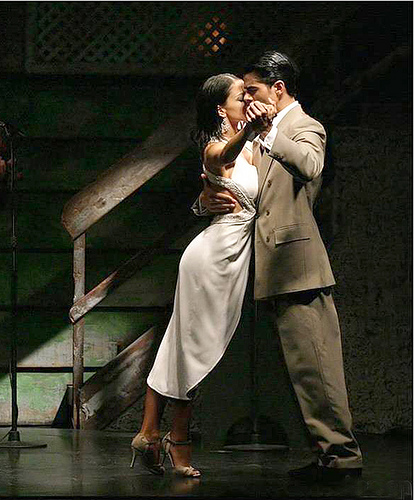
Prologue:  Lately, I have had wonderful discussions with tangueros and tangueras all over the world and so I hope to bring their wisdom to Tango-Beat.  This is the first Diálogo Tanguero (Tango Dialog) of  what I hope will be many to come.  My conversation below is with a forensic psychiatrist in one of the most populated cities in the US.  Over a cup of coffee, she told me about incidences that influenced her from her childhood, and how these influenced her pursuit of happiness through tango.  An earlier post “Tango Start Line” was about dancing for only your partner and not competing or dancing for the onlookers.  This dialog grew out that article.

Tango-Beat:

What brought you to tango?

María:

I grew up in Colombia, and I listened to tangos all the time.  My siblings thought I was strange because they were listening to rock ‘n roll, but I was influenced by our father who constantly would listen to tangos and boleros.  I loved these classic tangos.  I knew all the words to them by heart.

Mark:

You are a forensic psychiatrist, and you are summoned internationally in your work.  No one would ever guess that at night you come out as a tanguera!  And I am sure that few would ever guess you are a tanguera aficionada when you present papers to audiences, appear in court for victims or that you are treating patients.  My experience is that when we dance you are absolutely 100% connected to me and to the music.

María:

At work I present myself as plain as I can, with little makeup and very conservatively dressed.  Tango lets me be as feminine as I want to be, and that has really been wonderful for me.  Also, as a child I always knew that one day I would be dancing tango.  The reason for this is that my father always listened to tangos, and I have been listening to them since the time I was inside of my mother’s womb.

Mark:

You told me that you guide your tango teachers away from technique, choreography, and competition.  Instead, you are interested in the simple passion of the music and tango as a social dance.  Tell me why.

María:

I think I learned how unimportant competition is early on.  I want to dance it for me and my partner, not what others think or see.  When I was 12 or 13, I participated in an all girl’s bicycle competition in my neighborhood’s club.  My cousins Gladys and Nubia, who were 6 and 8 years older than I was at the time, also participated.  In the middle of the competition, a girl ahead of me tripped over something and fell off the road into grass and mud.  Behind her I fell with others.  My cousin Gladys, came to help me to get back on my bike.  I still remember telling her, “You shouldn't stop for me!  You could win the competition.”  She answered, “It doesn't matter; the important thing is that we are all going to make it to the end. . . .Who cares about being the winner or not.”
On life's track: Against others or with others?

Since that day, Gladys became my favorite cousin, and what she taught me that day stayed forever with me.  Approximately two and a half years ago, when I started taking tango lessons, I remember telling my first tango instructor, “I just want to learn to do it correctly, but overall I want to enjoy it.  I don’t want to compete.”  I don’t plan to be a tango instructor, though if one day it I teach, it would be to help others less advanced than me to get better.  Being on a stage in order to have ovations from the public is not my goal.  All I care about is to dance this music with all my heart, because I love it.  

Mark:

But you have through your passion learned good technique, I think.  I danced with you when you first started and you have really become very good in a short time.

María:

Well, thanks.  But I think that I have learned quicker because I never forgot about dancing just for my partner.  With my teachers, I have had that very clear, that my wish is to be a good dancer, but technically good dancers often are sitting.  My hope has been that anytime that I attend a milonga, I’ll be asked to dance all the time, not because I am the best on the dance floor, but because men will be able to tell that I have passion for tango and I dance it with my soul.   So, my hope is always to be dancing to the end, like in my bike competition, where I did not win, but I was able to finish despite the bumps on the road.

Mark:

Well, I feel this when I dance with you.  It doesn’t take a forensic psychiatrist to analyze this!  You have rediscovered your passion for tango that you knew as a girl.  Now, you are dancing to it, but it has been moving your heart for a long time.  What a great story, María!


Thursday, April 28, 2011

Tango Dreams


I have dreams from time to time in which I fly.  I love flying.  It is so wonderful it wakes me in my delight and concern that it will end too soon.  Before I wake, I feel as if I must remember how this works.  Why couldn't I fly before?  Can I do it again?  All these thoughts make me lose elevation and I must land.  Upon landing, I wake, sad that it was a dream.

Tonight, I know that I will not wake up from these dreams anymore.  I will fly and not fear that I will forget because starting today, I will remember the fact that I can fly.  In my dreams I can -- every night, even before I sleep.  With my passion to fly, I am not limited by worry about my technique of flying.  Before writing this, I never realized the antidote to this sad ending to my dream.  But now I know that I will be free to fly without worry of waking to be disappointed.

The reason I will no longer be awakened from flying is something I learned from working with combat vets.   I will not go into it right here, but one of the single most rewarding things of my work as a therapist with soldiers is that although they had nightmares every night for years, with a new nightmare mitigation technique, the horrific dreams suddenly start to disappear.  Eventually they stop having to use toxic medications to induce and maintain sleep.  It is all about embracing the producer and director of your dreams -- you.  The producer is the raw passion of the film making what we do in our head both asleep and awake and is the limbic part of our brain.  The director is the technique, the cerebral cortex that tames passion and at its very best, makes passion sublime.  This concept has been around for centuries as "sublimation" -- that what makes passion sublime.  Unfortunately, the word "sublimation" has changed in its meaning to become "stuffing your passion."

Perhaps you will ask, what use is this if you cannot really fly?  Mentally when I fly, you will see that I am more serine and happy.  Being more serine and happy has multiple uses, don't you think?

I now have the ending to dream, and it has a wonderful ending:  I fly without worrying about technique because my passion got me to take flight, and hard-earned technique will follow because I am enjoying myself and I am willing to work for the next level.  In other words, passion is what makes us work to have technique that allows us to keep flying higher and longer.

Finding the ending of my stress dream, comes out of my life experience as a tanguero.  This is yet another practical application of what I have learned as a tanguero.  The soaring that tangueros experience all the time is very much like this dream.

I am suggesting that you more assuredly can soar in your practice of the walking embrace, commonly called "tango."   Nightmares have an overly active producer, and tango dancers often have an overly active "director," stealing away the very basis for the creative work of art you are about to paint upon the floor.

Give up the worry about your technique (although that  is very important) and put it into context of art and love!  Tango is an art and much more than that.  It is the art of flying with another person.  The arts hit their highest of highs through technique, but what makes them have the energy to take flight and soar?  It is your passion for art and love.

Let's say that we are both authors.  We write a novel about tango.  We have passion about what we write.  It is important to have good spelling and grammar.  But without our passion we have nothing.

Tango is love -- the love of movement and connection with another.  Let's say that we are lovers.  If were are truly lovers we would love each other with all our hearts and minds, and I would hope that our technique makes it all the better. But without our passion, our technique is nothing.

My best moment in tango is when I hold a woman, no matter how old or young, comely or plain, as the only woman in the world.  There is no technique to open your heart to the transfer of energy between two souls, but technique will help to transform this moment to be sublime.  And when this happens technique seems so important, and I can for a moment believe that technique brought me to this heavenly place.  However after a moment's reflection I will return to my heart:  Passion was what made us take flight, to soar; technique allowed us to fly high and long.

Will you fly with me?  With us?  Try it in your dreams.  But practice it with the soul who has assented to hold you as you go down the wooden path together in this magical, walking embrace, you and I call tango.


For a perhaps more balanced view of technique and it's importance, see this post:
http://moderntanguera.wordpress.com/2011/04/26/technique/

Photo credits:
http://vi.sualize.us/view/9f878a2f026418e54ca53b7917b261e9/  flying dreamer


http://www.dreamstime.com/dancing-water-image12124506 dancing water.

Saturday, April 23, 2011

Tango Start Line


Where are you in the line-up of dancers? How many are ahead of you or behind you?

It does not matter if you are an elite dancer. The great competition is within--and it is a grueling competitive event:  An obstacle course!  The quest is to be the best you can. For dancers I think it is the quest to be able to dance with yourself and with other souls freely -- not merely to be one of the best in the crowd.

Wednesday, April 20, 2011

How Close Embrace Feels to Penguins

I have heard that penguins like close embrace tango because it simply feels good to be close to another.  This is how it feels to me too.

I am not a zoologist, but a limited study shows that penguins enjoy close embrace tango even if there are height differences with their partner.  Here's some evidence for this assertion:

Sunday, April 17, 2011

High Risk Tango Stocks


Tango-Beat News Release:
High Risk Tango Stocks Crash

I would like you to be your own consumer advocate for what has become a hightly unregulated industry:  Tango.

People are buying High Risk Stocks in risky tango ventures -- thinking that social tango needs the whole floor to oneself as others enjoy watching you.  Commodity Funds in a bag full of steps and combinations.  Mutual Funds with fund managers (teachers) who have a large management fees but with a fund that usually has few dividends in making people feel good about themselves.  I recommend  Bonds:  Bond with the person in front of you and dance with their soul.  Make the tango walk the most important thing you do, and turns will start happening just so you don't bump into your friends, with whom you have also bonded.

First of all, we need to have a way to measure the risk of your investiment by knowing your Mutual Fund Manager, that is, your tango teacher.  We all want quality Mutual Fund Managers in our tango community, but unfortunately some have AUTISM, and you may not even know it!

Never heard of AUTISM?  It's the American Unqualified Tango Instructor's Society Membership.  No one is perfect but you don't want any teacher who has too many qualities for full membership.  My admittedly sarcastic litmus test for AUTISM teachers follows, but I promise at the end to present the solution.  It is remarkable, and NOT my idea.  Also, you will find NOT ONE item below that has anything to do with what you previously might have thought as being as "unqualified" -- such as "lack of experience."

How does your teacher score for AUTISM?   (5 is "very much so" and 0 is "not at all".)  There are eight items. Forty points means full membership and your Tango Mutual Fund is on it's way to being just paper receipts without any value (you give up dancing and your investment was poorly spent time and money).

The AUTISM litmus Test:
  • First and above all:  Make money.  Lots of it.  If someone wants to learn a volcada in a private lesson, don't suggest they need to learn to walk first.  Focus on what they want and it will cost them $560 at minimum to get that volcada, and then they might realize they cannot walk.  Now there is more money to be made!  [5= "very true of my teacher" and 0= "not at all true."]

  • Focus on technique and the science of tango not on the art of tango, after all tango, art and even holding a person's hand are all about technique and have nothing to do with heart-felt connection, right?

  • Focus on making wanna-be stage dancers.  When they finally look good they will feel good not so much about dancing but especially about how they are making money as teachers too!|

  • Criticize lack of talent and slow learners -- their own internal critic will make you feel just like the parent who couldn't be pleased.  Some will stay in your classes because they are used to criticism from their critical parents.  It feel like home to some students!

  • Make sure that everyone knows that your way is the right way/the only way.  Only through you can they know the Way, the Truth, the Light.

  • Use every opportunity to make tango your business (teaching on the dance floor) or doing an exhibition on the social dance floor among social dancers to demonstrate at every opportunity your awesomeness.

  • Make the assumption that being able to dance means being able to teach.  My motto is:  "Isn't that obvious that my greatness touches every aspect of anything I try?"

  • Give them a fish (not a fishing pole)!  Every legitimate tango move must come from some book or secret connection with a particular barrio in Buenos Aires.  No legitimate move could just spontaneously come from the music or the wonderful connection with a partner.  It comes from the Holy Book of Tango Steps, which is written in Hebrew.  You need a priest to translate it into English for you at the reasonable rate of $90 an hour.
There are so many wonderful teachers out there.  Look for one the way a great athlete does -- one that has results, and let those results be in making you feel good about yourself as a social dancer.

Where are these great teachers?  They are out there.  Some are professional and full-time teachers.  But others are just teaching for fun.  YOU are one of them.  Go to prácticas and help beginners, but start with some qualification like, "I am just one person, and each person has their own way."  Or, "This is just how understand what tango is."  Good teachers being omni-present in the tango community is not my idea.  Clay from Portland writes this (I give the link below the quote):

Teachers. The next tricky question [about community building] is who should teach? The answer is...you, along with everyone of your friends, neighbors, and acquaintances that knows the least thing at all about tango! I know this is contrary to everything you've heard and thought about tango, but tango is a folk dance and should be shared and taught by everyone. That's the way it originated, and that's the way it will promulgate. This is not rocket surgery, my friend, and the idea is to have fun and enjoy. Remember, everyone of those people that your neighbor, relative, and clumsy former student starts teaching is one more body brought into the tango community—and probably a body that would never have been there otherwise. Furthermore, once they see you dance and hear what a superior teacher you are, they will all end up as your student anyway.

Please go to his link on community building:  http://www.claysdancestudio.com/building_community.shtml
He also has a general page with many resources:  http://www.claysdancestudio.com/what_clay_says.shtml

Final Note:  My intent is NOT against good professional teachers.  It's all about BONDS -- connecting to others through tango as a social dance.  Sure, I love the visual effects of professional stage tango dancers, but I often just leave the room and rest at festivals during "show time."  It is truly all about BONDS and not HIGH RISK STOCKS.  Professional teachers are my among my coaches, guides and even my friends.  Find a great professional teacher!  But also learn from every soul who assents to dance with your soul.  That is where you will learn the most about tango.


Thursday, April 14, 2011

Lovers at First Sound (poem)


Lovers at First Sound

Two vistors at the milonga
Sit at the tables, just to watch.
Their eyes follow a dancing couple,
And whisper,
"Certainly they are lovers.
The way they look at each other
In silence and nod;
How without a word
She follows him out to dance."

He leads her by the hand in silence.
They share a knowing, silent stare.

They come closer and lean together,
Connecting, heart to heart as lovers do.

Watching each others' hands,
They connect as if it were their ritual.

A new phrase in the music suddenly becomes
The movement of two who have become one. 

"Certainly these two are lovers.
Surely, they have danced for years.
Look how their legs entwine,
Their passion!"
The two visitors whisper.

The couple dances a silent conversation, not a word,
They paint a masterpiece of love on the wooden floor,
A mural of their lives together, their passion.
How many times did they practice that --
The perfectly punctuated movements to the the music?

"Surely that must be their favorite song,
Danced a thousand times," she whispers.

And then suddenly -- or so it seems to the visitors –
The dancers stop. . .magically stop with the music.
He leads the third vistor, his dance partner, to her chair.
And the others overhear him say:
 "I so enjoyed dancing with you,
  I hope we can dance again tonight
  and anytime you might come to town!"

"But certainly they were lovers!"
Those watching silently wonder.

And yes,
They were lovers.
For that moment.
For that tango.
Lovers at first sound.


Note:  
This is a revised poem that originally appeared in November 3, 2009 as my first tango poem on Tango-Beat, titled "The Three Guests."

Tuesday, April 12, 2011

If the Cello could play the Violin


If the Cello could play the Violin
What music would he play?

If the Violin could play the Cello,
What song would she first play?
If she could hear his harmony,
What would she sing?

I hear a tango, inspiring mortals to dance.
I see the Cello, painting a canyenge background.
I feel her wet, soft tear
Fall upon the Cello's shoulder.

I hear the Violin recite a sonnet,
A story of love, joy and sorrow,
Told by her four vocal cords with his bow.
I feel his sonorous lows, rocking her,
Her soprano melody playing my heart.

You are that Violin.
I am your Cello.
Let’s play a heavenly tango.
Together.
Each other.
For our souls to dance.


Photo Credit:  http://www.terminartors.com/artworkprofile/Bereny_Robert-Woman_Playing_Cello

Saturday, April 9, 2011

Tangueras choose their men like golf clubs


Tangueros I think you will understand this.

Advanced tangueras chose their partner just like any golfer would chose the right club for the task before them.  Is it a long drive?  Are they in the sand pit or on the green?

Similar to a golfer, a tanguera avanzada will choose a putter-milonguero for a transpie milonga.  The 5-iron, the guy in the nice tie and dapper shoes for the vals.  And Mr. Wood, is her driver for long shots.  Perfect for music by Pugliese (here's a link: Osvaldo Pugliese).


This being true, gentlemen, why would you ever get her to respond to a cabeceo* before the music starts?  That would be like using a driver on the wrong part of the course!  She may know that you are great with everything except music from Di Sarli (Carlos Di Sarli); so she is avoiding you only because she doesn't know which club she needs!  

I received an insightful comment from an advanced tanguera, which I have added to the Tango Etiquette Page (CLICK HERE -- it's always in the right margin on my blog).   This is some great advice for both men and women on the cabeceo:


Graduate-level Cabeceo:  Gentlemen, pay attention to this tanguera's advice (Señorita N.) if you feel you are ready for dancing with the more advanced ladies who have different tangueros for every flavor of tango:  "For the cabeceo, the guys should always wait to hear what the music is before looking for a partner.   There are men with whom I would dance a tango or a vals, but never a traspie milonga.  You can acknowledge me as you dance by and then I will know you will will soon look for me.  The porteños do it by raising their eyebrows as they lock eyes.  Men, if you are only dancing with the young and pretty in the sparkly dresses, then you are missing out on some of the best dancers in the room. There is a reason all the young women flock to the milongas with the 70-year old me
n in Buenos Aires.  And it is not because they are tall and good looking, or have a large repertoire of steps.  It is because we old ladies have taught them how to cherish a partner."  


Now you have it gentlemen:  Golf does not mean "Gentlemen Only; Women Forbidden. It means "Girls Only Love Fun."


Give them what they want only after the music starts.


*A cabeceo is a nod of the head to someone who allows eye contact (usually between "sets" [tandas], thus avoiding asking someone to dance who might not wish to.  To see the fuller discussion on this go to:  http://tango-beat.blogspot.com/p/los-codigos-tango-etiquette-made-easy.html, which has links at the bottom for even more info.


Thursday, April 7, 2011

Musicality: the Pulse vs. the Music itself

Preface:  I originally wanted to write about musicality when I started Tango-Beat in 2009.  However, I was distracted by the richness of the psychological aspects of tango, then poetry took over too.  My first thoughts for a tango blog was to do what I had done in Germany and in Austin, TX with Salsa:  I taught percussion to dancers as a way to understand how to dance salsa. Tango has rich rhythms, and has far more diversity of what dancers can do with their bodies than salsa ever will -- as much as I love salsa.  So here it goes...

Just like in medicine:  Let's start with the pulse.  Is there one?

The Pulse is not the Music
Here is something that you may have never considered.  Dancers often dance on a pulse that the musicians are not playing.  Perhaps you have heard Spanish speaking dancers use the word "el compás" for this concept of a steady beat or tempo?

It is common to see people dancing to the music of a canyenge or tango rhythm with 6 notes per measure and the the dancers are taking four steps, only two of which are coinciding with what the musicians are playing.  The musicians are creating this pulse, but are not playing the pulse.  In fact, this is the main difference between dancers and musicians.  Dancers dance on the pulse (like tapping one's foot), but the musicians are only creating the pulse by playing with and around the pulse.

I found the perfect piece of music to convey this concept.  In the following video the bassist creates the sound of a heart beat -- perfect for "the pulse," ¿no?  The musicians come in and play around this pulse, using yet another rhythm that is the essence of tango/canyenge (1**4**7*| 1**4**7*).  We will return to this important rhythm as the essence of tango in a later post.  For now, get the sense of the pulse being mostly what all the musicians are NOT playing, but rather are playing around.  Also when you dance by yourself or with someone start to notice when you are dancing to the pulse versus doing some step that leaves the pulse and does what the musicians do.  I see advanced dancers who rarely leave the pulse.  More about this later, but please believe me that quick-quick-slow is just an extension of the pulse, unless the musicians actually played it.

Enjoy the pulse and notice the musicians playing around the pulse with this first video:


That was easy, right? You felt the pulse and the way the musicians played with and around it, right?

Some homework:  If you watch videos of performances of great tangueros/tangueras, watch when they often receive applause, or even better -- when they do something that moves you emotionally.  This moment is often when the couple has left the pulse and joined the musicians, even if it is briefly.  People talk about the couple's "musicality" mostly when they leave the pulse.

I am going to make this easy by giving you your first video to consider.  Please watch this next video and tap your foot or clap to the pulse of the music. Notice how wonderfully Daniela and Luis sometimes do things that "play around the pulse" and how this brings an artistic value to the beauty of their flowing movements using the pulse.  Also, notice how some sweeping movements follow the violins.  Luis gives Daniela time to play along with the musicians, using so-called ornamentos.  Often these are done on the pulse but she leaves the pulse and also often joins the musicians with her ornamentos.


I hope you could see with new eyes concepts of musicality.  Watching several times is even better.  You will see new things each time.

In the my next post on musicality, I plan to write more about the pulse that the music makes versus the music itself, but the above video should get you thinking inductively about this first.  The goal is to help take you a more expansive level of musicality in your dance improvisation.


PS:
Please give me feedback at mark.word1@gmail.com or leave a comment!

Friday, April 1, 2011

Being great: In your dreams, Tanguero

Dualing Tangueros:  Who will win?


I had a dream last night.  I dreamed that I was dancing near an experienced tango teacher, and although I did not look up, I could tell that all eyes were on him.  He was swirling around, doing all sorts of cool moves.  My job was mostly just to creep behind him and make sure that he didn't hurt my tanguera with high-flying boleos, ganchos or simply slam into my tanguera as he went forward and backwards in the space that all we lesser tangueros were humbly providing him.

This was my realization:  Why should I be so meek, dancing just for one person, the woman in front of me?  In my dream I reasoned that if my partner were sitting at the tables, she too would be watching his awesomeness.  She would not notice me -- the guy who was taking subtle steps and moving to nuances in the music.  She would not see how I had connected directly to my tanguera's heart and entire being.  She would not see that I was dancing with my partner's soul, led to move only by the music rather than showing off what I just learned from a stage star.

I woke up and looked at the clock.  It was 5 a.m.  I remembered that even though it is Friday, I have the day off.  So I went back to sleep.  But I started dreaming again.   I felt myself loosening my connection, as I considered my partner sitting there watching this great show going on next to me.  I thought that this woman who had melted into my embrace with her eyes closed surely would be watching the great tanguero, just as every eye was on him now.  She too would be amazed at that whirlwind giro with 12 different sacadas ending in a nice barrida.  Surely, my partner would have swooned with how the tango star had led his partner to four salsa-like turns and ended with sentada.

My dream continued.  I took action.  Like dualing tangueros, I opened up and did things he couldn't. Using my knowledge as a percussionist, I was now dancing on the upbeat as she stayed in the downbeat, allowing her to make these great egg-beater turns and colgadas.  She continued dancing on the pulse and I now was doing these truly amazing turns while dancing in a syncopated canyange rhythm.  I was truly awesome.  Finally like him.  He backed off and now was protecting his partner from my moves.  I was winning the dual!  People were watching me, the former meek milonguero!

Then I woke up.  It was April 1st.  I was relieved.  It is better to be a fool on the social dance floor in one's dreams than in real life.

When art becomes at its center a competition we all lose


Happy April fools day everyone!


Photo credit:  Tango Fire advertisement at top.
For dualing pigs:  http://sean-ashby.blogspot.com/2010/06/dueling-banjos.html

Wednesday, March 30, 2011

What to say to a non-dancing partner

Remembering who you once were is the task of growing up

I think that if I could write a book on how to motivate a non-dancing partner to dance, and the book actually brought people to accompany their dancing partner to regular dancing, that I could rest and prepare for death.  I would have accomplished more than most winners of the Nobel Peace Prize. 

Men and women reunited in an embrace on the dance floor because of something I had written.  Wow!  What a great life accomplishment that would be.

Surely there are many who divorce over this issue too, but many people I know learn to dance together with their spouse, and then one just drops out.  Meanwhile the dancing spouse goes on to love it and love the dance community.  But this is tragic.  Dancing is joy shared and at its base what men and women as couples do best.  It is playful, elegant, and perfect communication without words.

So I will address one aspect for your non-dancing partner.  I hope this helps:  Kindly suggest that dancing is the true youThe one you forgot about or lost as a child.  Speak for yourself, not for them.
Did you know that moving to music is one thing we humans are driven to do, but other mammals are not moved to get up and dance as we are?  Human beings are unique among mammals for this. We know that music affects animals, but please speak up and tell me if you have ever seen another mammal dancing in the way you have seen people spontaneously dance! My children went "motorically wild" with music. Have you seen baby animals moving to Motown music lately? Animals can be taught to walk to music or "dance" but it is only the product of behavior modification.

On the other hand, through negative behavior modification people can also lose their desire to dance or move. Teen boys, for example, in America might think it is not cool or out of fear of public ridicule/rejection avoid moving to the music (unless drunk perhaps). Being worried about what others thought was my teen-years experience, and now it is my sons' experiences in growing up in Europe. So, ladies, tango may be the first music that some men are allowing to revive their core as a human being! Be patient with them.

 Fear or actual rejection for moving to music is a very strong emotional current for many men, including myself. If you knew me, that may be hard to believe. Even after dancing many Latin dances and now tango, it still smarts to hear the criticism behind my back about my dancing. (I am only told this because the "informants" love the way I dance, and they think that I must "know" that this rejection is groundless or simply male jealousy.)

So moving to music -- eventually even in public -- is both a wonderful thing to re-awaken the core of being a human being, but also it is a way to assert your grown up self that wants to recover what was lost along the way:  Your essential self as a dancing soul, reborn to what you once knew as a child but have forgotten.

"Ye must become as children in order to inherit the kingdom of heaven."


Photo credit:  http://www.kalamu.com/bol/2009/03/16/various-artists-%E2%80%9Cmotown-reggae-samba-mixtape%E2%80%9D/

Sunday, March 20, 2011

Tango Music: It grows on you

Tango music should not grow on you ... but it does for most dancers.  Why?  I just recently figured this out.

Imagine that you were just walking along on a vacation in Holland, and you stood there at an outdoor concert and you see this orchestra and hear this music for the first time:


Chances are that you would say, "What in the heck is that? I love it. It's amazing." What you probably would NOT says is "that music might grow on me and I might like it after I understand it better and learn to dance it."  Do me a favor and listen to the last moments of the video again.  Listen for the crowd experiencing what you probably never did:  Absolute awe of a type of music they had never heard before.

Let me introduce to you the same sextet but by themselves.  Had you heard Sexteto Canyengue live or on a good sound system you would have had your socks knocked off.  (Note that the video clip includes different moments of their concert and is not just one song.)


I bought the above live recording while I lived in Germany. I was amazed. I love the musicianship of this orchestra. Go to YouTube directly and you will see that many people do not like it (as of today 13 "likes" and 7 "dislikes.")  Many love the old orchestras, evidently. I do too.  But not all of this recorded music is faithful to what the musicians were playing.  DJs need to be picky about fidelity of the music.  Playing poorly recorded music makes it hard to hear, dance and appreciate. Many DJs never bought a recording of tango in their lives. How do modern musicians make a living if we do not appreciate them with our purchases of new/old music?

In talking with a tanguera about this phenomenon, she pointed out that once you learn a dance that belongs to the music, the dance changes the way you appreciate the music. This is less true for me. I was a musician and was introduced to nearly all music as a listerner/musician. I learned salsa after buying a book on Afro-Cuban bass. I told myself that I had to learn how to dance this music. But she is right -- I learned to play jazz, but after I learned how to dance swing, I became a better jazz musician. Dance does a lot to enhance how we hear music.  I am sure that learning to dance tango has been the most important reason I have learned to love it "through the back door."  Only recently did I realize why tango did not hit me like hearing reggae for the first time, which just floored.  Scratchy records with absolutely no bass for reggae would not have had me amazed or wanting to hear more.

No music slowly has become a strong favorite for me, and I love most everything which is done well from the start.  Only tango has exponentially grown to be now not only a favorite but clearly my favorite music.  As a musician I was almost always the unusual member of the band because I had the widest collection of music -- listening to Mozart, Brahms, Bach, and Miles Davis on the way to a gig in my van with fellow rock band members.  They thought it was weird, but it was my van so they had to listen.  That was music appreciation 101 for a captive audience!  It started to grow on them, especially Bach turned all the way up.

I have heard people say that at first tango sounded old fashioned.  This too is only a perception that starts from scratchy old-sounding recordings, I believe. Young people who listen to a well-mastered tango might think it is something brand new!  I have shared it with young soldiers, and the love it.  My children love tango, but I would never give them some old scratchy classic.   Fidelity is everything in two areas of life:  Music and marriage -- being faithful to the original. That makes playing poor recordings tantamount to adultery, don't you think?   :-)

DJs often have a collection of music that was given to them, and maybe in a MP3 format, taking yet again a level of fidelity from it. Tango played by excellent present day musicians, recorded in a digital studio and played on excellent speakers blow ANYONE away. It is incredible. So the below list of orchestras is great, but do not be shy about finding new recordings and helping present day musicians who are faithful to the old classics.

I am suggesting that we support new recordings of great classics. Also, below as a part of appreciating and understanding the music of tango, I am including a list of some of the best know orchestras. Each has it's own flavor and interpretation. Each should cause the the dancers to alter the way they dance, just as each orchestra might alter the way you feel, make love, sit in your car or whatever while listening to music.

If you heard rock 'n roll for the first time, and thought it was cool, wouldn't you be happy to have someone tell you about a band called Led Zepplin or the Beatles?

Here is a good list of the best known orchestras but don't forget the new recordings of the old stuff and totally new tangos being written!

Angel D’Agostino

Alfredo De Angelis

Juan D’Arienzo

Rodolfo Biagi

Miguel Calo

Francisco Canaro

Julio De Caro

Alberto Castillo

Lucio Demare

Edgardo Donato

Roberto Firpo

Osvaldo Fresedo

Pedro Laurenz

Francisco Lomuto

Orquesta Tipica Victor

Ciriaco Ortiz

Astor Piazzolla

Osvaldo Pugliese

Enrique Rodriguez

Carlos Di Sarli

Ricardo Tanturi

Anibal Troilo

Friday, March 18, 2011

TOGA Party Suggestions


TOGA Party Suggestions

True tangueros are not male elephants.  Well, most are not.

I am not talking about size or smell or the amount they eat at the snack table.

Male elephants are loners.  The bulls go about life just finding the next "dance" and fighting other bulls.  True tangueros, I believe, are not bulls.  Female elephants like bulls; tangueras do not -- at least the tangueras I know.  So let's cut the bull.

Recently, a tanguera friend told me of a problem in a small community I've never visited had a "bull" fighting over territory.  I will give him an alias name to protect the innocent:  Bull E. (the older, experienced dancer) was hassling a the less experienced dancer.  Evidently Bull E. felt the younger tanguero was using too much space on the dance floor and told him so.  Ironically, Bull E. is notoriously all over the floor, zooming between lanes and then ends up in the middle doing super-cool-look-at-me stage moves.  Now if the younger dancer joined the bull at his own level, what would we have?  Two "bulls" having a fight to the death.  You know the center of the floor is really not used very much; so why not have it out there?  Make it quick, of course, during a cortina.  Or maybe not -- on second thought.

Here is my suggestion for "cutting the bull out of your community," if fighting to the death is contrary to local laws and codes of ethics:  Especially small communities need a TOGA party (TOGA = Tangueros Only Group & Association).

I imagine a TOGA party could be a sub-party at every milonga, but I think that an informal men's group could be very helpful.  Women have been great at defining their role in modern society, but I feel that we men are way behind on defining what it means to be a man in the modern world (now that we fully acknowledge that women have brains).  The tango community is a great place to learn what it is to be a man with a brain in a world with women who also have brains. I am not being sarcastic here, really.  In some ways, tango simplifies male energy and female energy much better than in modern life.  Female energy -- if you have read any of my earlier blogs -- is not subservient or submissive but essential for male energy to co-create and truly dance.  Male energy is ... well, what is it? That is what TOGA party would be for.  I mostly know what male energy is by what it is not:   Male energy is NOT fully to blame (as some teachers say) if things are not working.  Male energy is not just talking to a submissive energy that is doing all the listening.  It is not JUST pushing, pulling/pulling/indicating (marcando), dragging (arrastrando).  My best guess is that the male energy is part of a magical mix of yin/yang, male/female, thesis/synthesis or the musical note/musical pause that creates something far too complex and magical to name in human language.  We men could be far better about figuring out what it truly means to be a man in the modern world and that includes in the modern world of tango, which is full of very talented tangueras.

Mark's TOGA Party Online
In a sense this blog is my TOGA Party with many other men.  Today, a tanguero wrote me from across the world to say that he discovered my blog a few months ago, and he has read nearly every entry since 2009 on my blog.  He and I are not elephants, loners fighting over territory and tangueras, but finding connection as two men trying to figure out the magic of tango and how it affects our lives.  He sent me an email to cheer me on.  Welcome to the Online TOGA Party, Tanguero!

What do you say, Tangueros?  Shouldn't our Tangueros Only Group & Association should have a vision statement and tenets?   Here's a rough draft (I'd like your ideas too):

TOGA Vision Statement:  Group members help define their role in the community to make it supportive of new members and a sanctuary for those who have long taken part in the community.  Tangueros play an active role with tangueras to help the community to grow in it cohesiveness.

Tenets for Social Animal Citizenship as a TOGA member:
  • Introduce yourself not just to tangueras but also tangueros.  Get to know them.
  • Recognize how other men influence your dance and actively appreciate them rather than competing with them.  (The tango floor may look like a race track but the competitive mind is usually the loser on the social dance floor.)
  • TOGA members are protective of the vulnerable partner (bare legs, open shoes, sometimes with her eyes closed) and are working with other Tangueros to keep the entire flow of the milonga safe and fun.  [Tanguero=the role not one's gender.]
  • Cutting the Bull:  TOGA members do not participate in BS, which includes aggressive posturing, territorialism, dangerous moves, racing through a tight dance floor, or trumpeting (excessive talking-while-dancing).
  • Let's talk about the biggest pile of BS:  TOGA members will pull a bull aside and gently ask him to join the human race.  Here is the worst kind of bull and his M.O. --   1.  A novice tanguera arrives in the community.  2.  He uses his intermediate to advanced tango skills to become her lover,  and then lastly, number 3.  When their affair comes to an end (as it has over and over), she is then forever gone from the community and probably tango, eschewing the beauty of tango as a dangerous addiction.  Her disappearance is a huge loss for her and the entire community.  TOGA members do not tolerate this BS, nor should tangueras.  But, Tangueros, why should the women have the job of confronting this bull!?  If a tanguero and tanguera fall in love with each other from the community, that is a different thing altogether.  People somewhat established in the tango community are "consenting adults." But seducing novices over-and-over is not okay at all.  Every larger community has at least one of these bulls.  TOGA members are watching you!
A note to the ladies:  
TOGA is for men but it is truly all about those whom we adore -- you!  Tangueros are not exclusively men either, but those who dance in this role.  Many readers of this blog are women.  I am not excluding you.  Women lead the way in most tango communities with their own Tangueras Only Groups (TOGs).  These groups bind together the tango community, enhancing the cohesiveness of the community by developing solidarity at several levels.  Ladies believe me, you don't need a bull in the milonga china shop, and the TOGA Party may be the best way to cut out the bull entirely.  I am not BS'ing you.  :-)


Photo Credit:  Joanne Tullis http://www.city-data.com/picfilesc/picc44622.php 

Wednesday, March 9, 2011

Imagine a Milonga with only ONE Leader!


A milonga with one leader would be the best milonga you have ever gone to.  This is visionary.  It won't happen in my lifetime.

I am imagining in this visionary milonga that music is the only true leader.  Sure, men have their masculine role but would not be telling woman how to move -- movement dictators.  And woman would have their role, allowing multiple possibilities and new ideas "between" each impulse the man provides.  I said "visionary," okay, but this is what I try to do with every tanda.

March, I have promised myself, will be musicality month.   This article will presents the same piece of music (given above) which I will focus on later, and in that article I will explain what I call the "Di Sarili clave."  If you are curious what "la clave" is in Latin American music, including tango, please stay tuned.  The idea is to know better what the music is saying in order to allow it to lead you.

But for now, let's go back to the foundation of all musicality:

Men don't lead.  Music does.  Music gives the impulse for humans to move through rhythm, harmony and melody, the holy trinity of music.  Men do not give this impulse, unless the woman is deaf and feels the music only through the music he hears, which is a beautiful possibility.  But until now I have never danced with a woman who is truly deaf.  I have danced with many women who have been unwittingly trained to be deaf to the music.  The training comes from poor teaching and the experience of men who are mechanically constructing what teachers have taught them and hoping it will fit into the music somehow.  Shame on teachers who teach steps.  Music teaches steps.

Women can have this mantra of freedom:  "There are two types of men in the world:  Those who dance to the music and those who do not.  As I dance with a man I will discern which type of man he is.  If he does not dance to the music, then I will let him lead."  So it is true that some men must lead what they do because the music is superfluous.  Let him lead.

Men can have this mantra for freedom:  "There are two types of women in the world.  Those who allow the music to lead them and those who rely on the man to lead.   I will "listen" to her movement, and if she hears the music we will dance to the music's lead.  If she relies just on me, then I must be patient with the delay in her steps, caused by following me and not the music."  If a woman does not feel the Di Sarli clave, for example, then I cannot easily dance to the music.  She does not have to know what this is, but she must feel it.

A discussion of this can change things, but ONLY at a práctica.  I used to keep dancing with these women, but it becomes such a chore to have my main job not as a dancer but as her Musik-Übersetzer.  I will eventually avoid her eyes at a milonga.  She hurts my right ankle when she does not dance to the music.

Ladies:  I think there is a cultural belief that men often do not hear the music.  Do you know how hard it is to have the responsibility to translate the pulse of the music, be aware of my own feet and yours too, especially since most have been taught that the music is not the leader?  This is a good research question about gender differences and hearing the music.  With training women can be the less skillfull of the two sexes if she has been trained NOT to listen to the music.  And this is the problem:  The majority of tango teachers teach women to rely on the man to lead.  Please do NOT give yourself over to his lead.  Give yourself over to the music first.  Dance for the music first; your partner second.  Have you ever noticed that people start dancing after the music starts?  This is a good indication that we dance because of the music not because of our partner's lead.  Obvious, ¿no?

I can understand why teachers tell men to lead and women to follow.  But sorry.  They are sadly mistaken.  They have abbreviated an important step.  In Argentina, perhaps, one can assume that the women not only have heard tango all their lives but that they are truly listening.  Not even in Argentina is this 100% true.

IF WOMEN are listening to the music men can now do other things.  They make an intention.  The great tanguera then moves in such a way that allows him to create things within the music.  This is the male/female biological model as well, isn't it?

Paradigm Shift
What happens when there is a philosophical change -- that the MUSIC leads?  This is my experience:  I dance with a woman at a práctica.  I mention that I want her to own the music and allow it to lead her.  I then see a huge change in the way she dances.  It is important, then, that dancers understand philosophically that allowing the music to be the lead makes my job easier.  I can have that philosophy and that will help, but only when I have a tanguera who allows the music to be the lead, then  and only then can I truly dance.  And only then is she free to truly dance.

Ladies, please read "The End of the Lead is Near."  Click here for the link.  I am not suggesting that you leave the feminine engergy of your role.  A man gives the inpulse (the note) and you give the pause (the rest).  This is the musical analogy.

No step should be taken in tango unless it is led -- by the music.  

Thursday, March 3, 2011

My Old Guitar (poem)


My Old Guitar

I played my guitar to soothe my soul,
Playing a song I wrote for her.
For tangos we once had danced.
For the love we once had shared.

The seasons of my life are songs
I have played on my old guitar --
For those who have died,
For those I have loved,
For those who left me or I them
Along my vagabond pilgrimage on earth.
My guitar soothes my aching soul.
It is the Balm of Gilead for my heart.

I built a fire for the mood of this rite,
To sing a goodbye song for her,
And burn a letter to her with my hope
That the smoke might carry away
My burning message to her.

The fire cracks and I hear a voice:
"Take this in your hands,"
     the form coming up from the fire says.
The guitar that he gives me glistens.
Its form hypnotizes me and others.
As I play crowds of people surround me.
The music throbs out a primal chant.
Each time I play something fast, they cheer.
Somehow I perform this music I cannot feel --
Like a dance in shoes that are not mine and mere steps;
Like a tango composed with my feet but without my signature.

No matter.
The crowd is yet larger than before.
Cheering. Hands in the air lilt right and left.
Candles waving in their hands.
The host watching roars its delight
Of the soulless music my fingers produce.
As I stop they cheer all the more.

The firey figure grows larger and recites this incantation:
"Give over your old guitar and I will give you a name!
 Give me your instrument of solace for a life of fame!
 The co-creator of songs, for this one which glistens.
 Its mystic strings will perform and all will listen!

Without delay I gave him back The-One-that-Glistens.
"I would rather perform for the tanguera I love,"
I tell him, "And write songs of love from my heart
Or songs of hurt for my heart than to perform for millions."

The fire cracks and the form fades with his guitar.
And my old guitar and I return to our mourning
For the tangos she and I once danced,
For the tangos we composed,
Written with our feet and hearts,
On the parchment of hardwood,
And signed together at the bottom.


Photo Credits:   


Dick Lowthian  Old Guitar.
http://www.pbase.com/lowthian/image/75001115

Burning love letter
http://www.flickr.com/photos/hbombexplosion/3344010594/

Monday, February 28, 2011

My Tango Vows

Tango Vows Cake


I shouldn't think about divorce before I even take my vows.   But maybe I cannot stick it out with tango.  You know I look around and a lot of people were in love with tango, and they did not make it.  They divorced tango. 


Why do people give up on love?  I am writing this to decrease the risk that I (and those who love tango) will not quit for poor reasons.  A good reason is that you have died.  You danced until you died.  The best reason to quit.  And I write this for myself as a self-reflection on keeping the focus on what is important in dance -- my soul remains a dancing soul.


I wish we had some social scientists helping us out with the positive models we have all around us.   Wouldn't it be great to know what keeps people dancing until they die, after years and years of dancing?  Look around and ask the "survivors" about how they have done it for over 7 years?  There are so many who stopped dancing, and you cannot easily find the vanished host of tango ghosts -- those who have disappeared through the years since you started.  Sure some have moved away and are dancing somewhere, but most just simply disappeared entirely from the tango world.


People who quit anything have "reasons" they tell themselves.  These reasons, I believe, are often external -- other people and situations. Ask those who continue, however!  The ones that make it, probably are not exclusionary or cliquish at all.  Those who keep dancing have found ways of renewing their joy.  The  locus of control is internal, not external.  At least this is my best guess from "interviewing" people who have been dancing tango over 7 years.  And for some it is not a problem or bad that they quit. They simply had a different goal than tango.  Perhaps tango was a check mark on their "Bucket List" (do-before-kicking-the-bucket list).


In a discussion with a favorite tanguera who has been dancing tango for eight years, I found out that she believes that if people make it past three years, they will stick with it.  But I doubt that this is true.  Another favorite tanguera believes in the "bucket list" theory.  "What if you meet the right soul-mate at tango, but tango is not that important?" she asked.  Good point.  But personally, I feel that drop-out rates happen because of adverse events and do slow after three years.  Even with the "soul-mates" -- one was jealous and did not want to continue.  Both quit.  This is an adverse event -- not learning about jealousy.  The same issue will come up later in a different community, and "having to quit for you" will be always over that couple.


I suggest you go to survey #5 "Why did you quit tango?" Click here for the survey.   Those who have quit more than any other factor say that people in tango were too exclusionary and cliquish.  This is not the best social research because responders (those who have quit) must go to a tango website and take the survey.  I would guess that most who quit don't look back or frequent tango web sites to take surveys!   But I think the responses are somewhat thought provoking.  Whatever the external reason is for quiting, however, there is a much more important internal reason.   My guess is that the internal reasons include:


  • Tango was one of many opportunities to grow as a social animal; it was just a hobby.  The hobby is over and another one took its place.
  • Tango was a place to meet a partner.  Checked the block.  Have a partner.  No longer dancing.
  • One or more adverse events:  One got one's heart broken, and going back was too hard.  The songs have too many sad memories attached to them.
  • The negative cognitive frame:  Tango was framed as an "addiction"; the medical business model won out.  You may have been obsessed with tango (like being obsessed with washing your hands or whatever), but this negative model of "addiction," predetermines that stopping therefore will be something positive, even healing.  
What is Your Risk of Quitting in a few years?
Mine is not zero percent.   I could quit tomorrow.  I know that tango is good for me on several levels, but I could very well retire my shoes and go do something else in spite of tango being good for me.  Let me explain a little about risk:

I remember asking alcoholics in my first group-therapist job of what the likelihood was that they would return to inpatient detoxification.  Those who said "zero percent likelihood" were actually the most at risk.  Those who face their own frailties are most likely able to make changes that will better their lot in life.


So I am looking at my frailties.  It used to be that poor floorcraft around me would ruin my night.  I am learning to mellow out a bit.  If not at the milonga, I would have to learn this somewhere else, right?  I have learned that I can allow people to be in their own little clique.  I have found that they need this for different reasons.  When I have found out, I have understood and accepted.  Even if they are just small hearted, why not let them stay in the group of the small hearted?  The tango community is going to have the same problems one finds in a church or synagogue; so leaving a tango community is just putting off with social skill development via avoidance of personal contact.  Certainly you will not get as many hugs at a church or synagogue.


When will you quit -- get a divorce from what you now love and show full devotion?  I want to dance through my life.  I haven't said my "tango vows" yet, but I am writing them.  There is a phrase I am considering:  "Until death do us part."  Of course, I am talking about by worn out tango shoes.  The soul never stops dancing.  Anyway, I can't imagine that heaven would really much fun without a milonga.  But the shoes?  We must indeed part sooner or later.

Thursday, February 24, 2011

We are the Arch (poem)

The "apilado" or shared embrace of tango argentino


We are the Arch

It takes two ... for an Arch.
We connect and our feet have room to play.
Others cannot see what we do in our dance.
Can they hear our hearts beating together,
Or our breath in synchronicity to the music?

The arch of shared weight is the greatest mystery,
To those who might watch us.
I am not a pillar on my axis, but part of an Archway.
Above us may be the weight of the world,
But together we are strong.
And below us, our feet have room to play.

We are the human arch, you and I,
When our hearts connect.


Photo credit of Apilado couple (tango embrace):
http://www.flickr.com/photos/pacoromero/2311524702/in/photostream/

Photo credit of archway, and please visit some great views of arches:
http://www.domoblue.co.cc/archway-trellis.html&page=5

Wednesday, February 23, 2011

Dance Shoes and Roller Skates


Dance Shoes and Roller Skates

When I arrive at the dance tonight,
I hope that you are not there yet.
I hope for a slow tango to be playing.
I need to prepare, breathe, slow things down.

I have learned a lot since being a kid.
I would put on my skates.
I could not wait
To fly on wheels again.
Each time in my excitement
I was forced to roll into the restroom.
What a challenge that was!
I thought I'd never learn.

But I am getting better.

Now, I have a new pair of skates,
   my dance shoes.
My heart flutters.
I want to fly again!
I try to get there before you do.
I hope in vain for a tango I don't like.
Yet if you are there,
And especially a milonga is playing.
I fumble to put on my new skates.

Then we fly together.
Nothing has really changed,
Except rolling into the restroom.


Photo credit:  the Kentucky Historical Society
http://www.lrc.ky.gov/record/Moments07RS/24_web_leg_moments.htm

Tuesday, February 22, 2011

If Einstein had danced tango


Part 2  of "The Theory of Relativity and Tango."

If Einstein had only known about tango, perhaps he would value it as much as a particle accelerator to study the origins of the universe and his Theory of Relativity.  You see, he valued creativity, saying:

“The most beautiful thing we can experience is the mysterious. It is the source of all true art and science.

He to whom the emotion is a stranger, who can no longer pause to wonder and stand wrapped in awe, is as good as dead —his eyes are closed."

Although Einstein focused on physical reality, he venerated experiential reality as well.  When an hour of dancing leads you to feel as if time stopped or time sped up, please take note.  Why!  Why did this happen?  Which do you prefer? Can you alter outcomes?

Under the microscope of a meditative mind, time shows its plasticity both in quantum physics and metaphysics.  One would think that the plasticity of time should inspire some scientific exploration into slowing it down.*

If not scientists, then dancers must do it!

This has become my new goal in tango:  Find where time slows down even if the dance is a milonga or a fast tango.  Many dancers are experiencing time slowing, but the negative frame of "time goes fast when you are having fun" may hide the phenomenon from many tanguer@s.  Here are things to look for.
  • A sense of being so fully in the moment that time seems to stop or feel as if it is in slow motion.
  • The feeling as if the music led everything that happened and both responded in an equal way.
  • A blurring of anyone else in the room and only one's partner is there.
  • The intensity of information transfer, as if one knows about one's partners life, their day, their triumphs and struggles--  all through the walking embrace.
  • A sense that through movement/music/embrace the brain is organizing information clutter, allowing the information overflow to be managed in nice folders.  (When this happens at a deeper level with trauma or critical stress events, it will feel as if centuries have passed in a single tanda.)
Steps for Slowing Down Time
Other than going at the speed of light for a period of time which also slows time
  • Meditate in the walking embrace regularly. Imagine that you and others are sharing a walking-meditation Zen labyrinth.  Other couples are an active part of an amazing, moving, biological maze.  Dance simply, meditatively.
  • Practice mindfulness while in the walking embrace.  Mindfulness is being fully present with your partner and within yourself.  Watching the mirror, noticing who just came in the door, or who will be your next partner are distractions that too often take us out of mindfulness. Talking-while-dancing evaporates mindfulness.  Dancing in silence is a basic tenant of Argentine tango etiquette for a good reason.  Tango is a walking -- not a talking -- meditation for two while others are silent!  However, the most disruptive moment to mindfulness may be concerned with how we might look to others who might be watching.  This takes discipline and is not easy for most of us. 
  • Find freedom from an outside locus of control.  Performance anxiety intrudes in on one's sense of timelessness.  Chan Park, in his book Tango Zen  suggests simplicity in our dance, which he calls, a "walking meditation for two."  Great book. Simplicity needs to be an agreement of what you are doing.  Many dancers feel they need to take their partner on an exciting ride.  And although this is something that is fun, it is also a trap if we do it all the time. Conversely, some dancers wait "fun ride" by believing that a great dance all happened only "because you led it."  Both of these points of view are about the "locus of control" for one's experience being outside of oneself.  (Please read the article "The End of Leading is Near," for a fuller description of both partners being active in their very different roles.)  The balance of dance roles disassembles the misconception of locus of control resides in one dancer and not at all or less in the other.
I wish you many centuries on the dance floor during your next milonga.

Comment or "like" Tango Therapist's Facebook page at this link
or


Photo Credit:
The photo comes from the Huffington's Post on Einstein's view of spirituality.  I recommend this short and profound article.