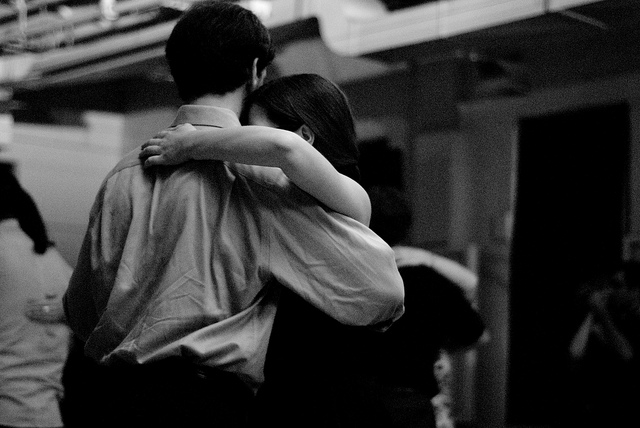
Monday, October 10, 2011

Breaking Bread: the Essence of Tango


Julia Elena, a local promoter and tango teacher in Washington, D.C., asked me to introduce an evening of live tango music and spectacular tango dancing.  The event was sponsored by the Argentine Embassy in D.C.

Perhaps I was the wrong person to ask.  I am not one to go to such an event because tango to me is a social event of feeling and connection, and stage tango seems to be -- at least at times-- the very opposite of my sense of what tango is.  Also, it tortures me to sit and watch tango;  I would rather dance than watch people dance.  To be fair, it is true that I am often deeply moved by performers.  Moreover, who can deny that great feats of balance, strength and beauty expressed at many performances?  I had fun this time because at times I was back stage moving around to the music.  Gott sei dank, I didn't have to sit down the whole time!

Below is the longer version of what I wanted to say.  The original was somewhat shorter because of time restraints:


Welcome to a night of Tango Argentino.  Tonight some among us have never seen this incredible music or seen this beautiful dance.  Tonight, if you are new to tango, I believe your life may be changed, as was mine six years.  How could I have been a professional musician and lived for three years in Latin America without knowing about the wonderful music and dance of tango until recently?  So it would not surprise me if many people tonight have gone through their lives without knowing anything about Argentine Tango.

El Tango!  What a magical thing!

"Tango" -- this is an interesting word.  Some scholars claim that it comes from the word "drum" or what people do around a drum.  Many scholars deny this, but perhaps it is because in tango today we mostly have orchestras without drums or drummers.  But I like this definition of tango.  I'll tell you why:  The dancers are the drummers!  In rock music, the drummer strikes instruments with feet and hands.  We tangueros and tangueras use just our feet.  Our instrument is the floor, and we accompany the orchestra.  Ideally, no step is taken unless the music requests that step.

Also, in tango we use the word "accompany" a lot.  The musicians accompany each other and we accompany each other on the dance floor.  In the best moments, the dancers join the orchestra as honorary members.  We dance this dance without prescribed steps.  We improvise and dance one moment with the rhythms which came out of Africa that are explicitly or sometimes hidden behind each tango.  Later in the same tango, we might change and follow the flowing lines of the violins.  Our feet might sweep the floor and slow our steps, crying along with the squeeze box, called the bandoneón, this iconic instrument brought from the Rheinland of Germany by immigrant musicians.  The dancers accompany the music, and the music, the dancers.  The woman accompanies the man and the man, the woman.  At this moment we all become tangueros and tangueras, sharing as couples and as a community.

Interestingly the central word of "accompany" (acompañar) is "pan" -- the word for "bread."  At its root "acompañar" means "to break bread together."  In the orchestra we see distinct roles of each instrument.  On the dance floor, the man and woman have distinct roles too.  Yet, we all sit down to "break bread."  It is as if I have as a man brought flour from the mill home, and my partner has made the bread, but we break bread together and enjoy its taste and nourishment.  This what we do in tango.  This is the essence of tango:  To break bread, to share in the emotions of life through music and dance.   Tango is sharing nourishment for the soul through music, movement and an embrace.

So tonight, if this is you first evening of tango or a yours is life-long experience, please accompany the musicians and the dancers and each other in this moment of the magic of tango.  When you do, you are truly tangueros and tangueras.

Enjoy the show!


Photo Credit:
Feet drumming  http://www.mynewsletterbuilder.com/email/newsletter/1410212127

Special thanks to Alejandra, one of the D.C. tango event editors, who had a great dictionary and a lot of curiosity about the way I was using "acompañar" as a replacement for "lead and follow" in an earlier post.  She is the one who discovered that "pan" was hidden in the word "acompañar." See "companion" or accompany in any good dictionary.

Saturday, October 8, 2011

Tango Percussionists Wanted

One example of using one's feet for percussion.

I invite you to stop dancing and join the tango orchestra as a musician?

A good place to start is to stop taking classes on musicality -- well, not quite.  How about at least thinking about these classes as musicianship classes?  Musicianship is not for advanced dancers.  It is for everyone, because in reality you and I are not dancers.  Most of us are just sloppy and or unimaginative musicians, until we join the orchestra as percussionists.  Maybe it is not a conscious thing, but I think the best social dancers are percussionists.

The word tango, like he word milonga, can mean several things.   Tango once meant a drum or a place where blacks would meet and dance to the drum beat.  Tango is still that.  But where are the percussionists now?  Every instrument in tango is used as a percussion instrument.  Name one that is not, but there are some percussionist who are unrecognized.

You are that percussionist in the tango orchestra!  A dancer is a percussionist, and the floor and partner is his or her instrument.  I do not mean this in a poetic way.  This is literally true.  Anyone striking any object to create or play along with music is a percussionist.  A pianist presses a key and a hammer strikes a string.  Thus a piano is a percussion instrument.  A vocalist clapping his hands is a percussionist.  A bassist using the back side of her bow against her stings is a percussionist. Of course the pianist is a percussionist/keyboardist.  Anyone who uses hammers, fingers, hands or feet in a musical way is a percussionist.

As a jazz drummer, I struck many different objects with both feet and hands.  As a tanguero, I use only my feet and legs.  I sweep (barridas), make grace notes (toe taps), and establish clear rhythms in synchronization to the music.  Besides the floor, there is my tanguera.  She bushes me, taps the side of my foot, scadas me, ganchos me.  We are the cello and violin playing each other.  As instruments of music, I am hers and she in mine as living, breathing instruments.

When I embrace another tango percussionist on the dance floor (a tanguera), I hope our goal will be to join the orchestra as musicians and not as dancers.  Anyone can get up and move, but can we embody the music as musicians?  I imagine that she and I have joined the orchestra as percussionists in the orquesta típica.  The floor is our percussion instrument.  We do not dance to the music, we play in the orchestra.  

Won't you join the orchestra?  When we all join the orchestra, we become the community band.  All the dead African slaves, tango musicians and composers who we highly esteem will be smiling.  We have come home.  Tango is a drum.  Play it.  Percussion is central to what we do at the milonga.

Photo credit:
http://www.drummagazine.com/lessons/post/foot-pedal-fanatic/

Next blog:  As a percussionist, we will explore why technique has nothing to do with how good you look or how awesome you play.

Friday, October 7, 2011

Map in her Shoe Bag

She did not know it was lost.
But she found it at the milonga.
She was not even searching
Or wondering where it went.

She found a treasure map
Hidden in her shoe bag.
Which would take her
Back to what she had lost--

Her own precious worth.

She opened the map and read:

Appraisal Need

When I hold you and dance,
I know what a gem of life you are --
Not a diamond in the rough
But an exquisite polished stone
With so many facets to bend light,
With so much depth within your bounds!
Only an expert in detail can describe you
And only a child fully can sense your worth.

I feel your inestimable worth
in your breath,
in your joy of movement
in the glint of diamond-eyes.

You, however, are the ultimate appraiser
Of your worth, your facets, your tone and timbre.
You must celebrate your uniqueness and beauty.

You are both the gem
And the appraiser.
Notice your detail.
Let your inner child
Sense your worth:

Priceless.
_________
__

She looked up and took his hand --
The one who watched her finish the poem.
They danced, but all had changed.
She danced in a new way,
No longer on a trip to find the forgotten,

She danced as she did as a little girl --
With innocent confidence.

Brilliant.

Radiant.

Priceless.


Photo credit:

Sunday, October 2, 2011

Tango as an Analogy for Business

Imagine that you return to visit your old office.  You resigned because of your heavy-handed boss.  He has since become a wonderful tango dancer, and it has transformed him.  Why?  What would you imagine to be different about him? 

Let me guess: It would NOT be because he now knows how hard it is to be a follower.  Instead I would guess that perhaps he now knows about partnership and how the mission (like music) really guides everyone.  He might be sensitive to distinct roles that work together wonderfully.

So when the corporate minds start noticing tango, great things might start happening?  Right?  Well, not quite.


Ira Chaleff's book The Courageous Follower has great ideas for the business world, and at some level tango can help in understanding the outcome he seeks as "partnership"; however tango as partnership should be applied and not the lead-and-follow analogy.

The tango community itself  has done a poor job developing the words to describe the magic of the distinct roles of men and women in tango.  Will the business world get a sense of what tango truly is if we have not?

In English we did not consciously decide to take "lead and follow" from ballroom over terms in Spanish.  But we did.  We didn't know better.  It is true that "seguir" (to follow) is used in Spanish.  But the word for the male role is to accompany his companion (compañera), not "follower."  Some, like Murat Erdemsel, has suggested we can drop the "f" and her role becomes "allower."  That's better.  I know this to be true.  Does she allow me to pause with the music?  Does she allow me to dance more than one or two steps on her left side before forcing me to go to the other side (like all of her teachers have told her to do)?  The other side to this is that I must also allow her to hear and respond to the music; so even this word does not encapsulate the spirit what the Yin-Energy of tango is.

Sharna, who is quoted by the speaker, once told me that the woman's role is best described as the "keeper of possibilities."  That's better than "follower" too.  The problem this term has, just like "allower," is that it works well with both roles.  The "keeper of possibilities" pertains to me just as much to my partner.  So, it is true that the distinctive roles are very well signified by "lead and follow."  But it ends there as an analogy, especially with each developmental step away from being a rank beginner.

We have so easily adopted all sorts of Spanish words less important than the the magic of the distinct roles of men and women in tango.  We could have said "tango dance" for milonga.  Or "figure eights" for ochos.  The list goes on of all the Spanish words we use.  Why don't we use the word compañero and compañera?

One can try to deny it but lead-and-follow as a concept is at its base is a military analogy.  It seemed to make sense in dance.  However, the magic of dance is poorly served by this analogy.  Today in the dance world and even tango we not only have a great deal of energy protecting these terms with dancers.  We have classes on both roles under these poorly chosen terms.  Are the roles distinct as lead-and-follow? Yes!  But being distinct as does not make them become these things.

Unfortunately tango classes are leading the way in defining this word "followership" for the rest of the world.  The business world, very conservative roles in marriage, the military, dictatorships and others can benefit by using the word we promulgate and have created.  The world can turn to tango as a great way of describing subordination!  ¡Que lástima!  Instead, shouldn't the world turn to the magic of this wonderful, improvisational dance to understand partnership?

Business and all sorts of human interaction could learn from the magic of dance and especially the innovative and extemporaneous dance that Argentine tango is.  However, the word "followership"used in tango is mistaken because the words were philosophically incorrect and limiting as descriptors of what tango is.  It is true that all words limit what they describe, but "lead and follow" lead the way as obstacles for understanding the magic of tango.  We couldn't choose two more misleading words!

I respect the outcome of Ira Chafleff's book, which is to get corporate leaders and subordinates to a state of partnership.  Yet, he is one among many who overstate the difficulty of one role over the other. He ends up saying that being a follower is harder than being a leader.  He quotes a scholar and one a tango teacher.  So what!  Followership is truly harder the more heavy-handed a leaders is.  Consider your worst boss.  Following him was more complex than his leading and more difficult.  Now let's consider great leaders: Kennedy, King, Gandi, Buddah, Moses, Jesus.  They had the easier role as leaders?  We need more than just a scholar and a tango teacher to persuade us of this theory.  Many tango teachers agree with Ira Chafleff and Sharna that the "follower" has the more difficult job.  Surely a tanguera's work is harder if she has a tanguero who is heavy-handed.  Has he taken his role as a "leader" too seriously instead of the magic of partnership within distinct roles?   Contrary to Mr Chafleff's hypothesis, even a female beginner who has no idea about her role can be taken down a magical path of dance Nirvana with a man who is sensitive to her abilities and a man who truly listens to the music.  Such a compañero will give her wonderful clues of where he will take her next.  Is her role at that moment harder?  These comparisons of "whose role is harder" is sadly counter-productive and do not describe the magic of tango as I experience it.  Rather, these expressions come out of the world of who-is-better or who-is-working-harder -- the world of discrimination against others.  This is the nonsense that women say to each other when men are not listening or men say when women are not in the room.  Nonsense!

In conclusion, the most important issue here is that a lead-and-follow is not what is happening in tango.  Men and women accompany (acompañar) each other on the dance floor.  The music leads.  Tango is far more magical than the leader-follower mistake analogy could ever convey.  Anyone who has experienced the magic of tango, I believe, must feel this in their heart.   Join the many who reject poorly chosen expressions to describe tango.  Join us in ushering a better way of conveying what tango is to beginners and even to ourselves.  The end of using lead-and-follow is near.


Note:
Also see an earlier post that used the full well-done video clip that is seen only in part above.

Saturday, September 24, 2011

The Secret Milonguera

Photo by Chirilalina  with permission

She still had not left town, I realized.

The out-of-town milonguera reappeared at a smaller, mid-week milonga.  The first time I saw her, she had danced nearly all night with her tanguero friend, "Fulano."  He allowed her to show off her great skill and grace, although he needed three times as much space as anyone else on the dance floor to do this important task.  Anyone watching her would want to learn how to dance tango -- such grace!

I did not know it at the time, but I began realizing that Fulano's milonguera was somewhat shy, even though she is a pretty woman and a skilled dancer.  At the first milonga, I couldn't catch her eye.  I figured she just was not interested in dancing my "dialect" of tango.  I was not going to directly ask her to dance.  It was up to her to allow me into her life with her eyes.  Without her eyes, the door is shut. No exceptions.

When I spotted her a few weeks later, I happened to catch her watching me dancing in the manner de los milongueros.  I figured that now she would know for sure that I do not dance in the way she likes to dance.  Surely, she wouldn't want to dance in such an outwardly simple way!  She had moves to show off!  Elegant ornamentos, volcadas, colgadas, boleos!

Then the inevitable happened at a small milonga -- we ran into each other at the snack table.  The conversation was pleasant.  Yes, she was a little shy or perhaps humble is the better word.  I also observed earlier that night that she wasn't acting like the normal tango-snob, which I had been expecting.

At this second milonga, she was dancing with a lot of different tangueros of all levels and styles.  Obviously she had missed the class on "proper-elevation-of-the-nose workshops" and  "how-to-avoid-tangueros-below-you seminars," given world-wide at campuses at the Tango Snob College.  Also, she miraculously looked good with whomever she danced -- or better said, she made her partners look good.

With a cabeceo, a nod of the the head, I was now dancing with her.  She had a great connection.    La Milonguera de muy lejos accompanied me as we joined the orchestra together, co-creating a walking embrace in reverence to the music.

Before dancing the second song of the tanda, I was still in shock, I guess, and I blurted out my pre-planned apology for dancing so simply.  "I am just a milonguero," I said with a pause, and then added,
"but I just try to dance my dance.  I really don't want to try to be somebody else."

"That's fine," she assured me.  "You know, all the wild moves are not really tango.  I merely enter the conversation that tangueros start with me.  I prefer milonguero."

Behind the performance tanguera facade, there was the Secret Milonguera!  I thought she merely understood my milonguero dialect and even knew how to hold a nice conversation.  Bu she was more than fluent in my language:  her mother tongue was milonguero and her second language was stage tango, which obviously helps her survive in the world of Showtime Tango.

I really do need to keep learning lessons like this.  The Secret Milonguera gave me another confirmation of the path that I have taken.  Hers is not a new lesson but a continuing one:
  • I want to keep dancing my own dance.  I want to dance without trying to impress the woman with what I might think she is expecting from me.  In other words, I want to be authentic in my tango.  
  • I want to co-create with my partner, led by the music -- that this is what truly satisfies the soul.  
  • Just because a woman can dance "fancy" doesn't mean that she wants to be on a crazy ride that shows every cool move I have ever learned from performance-focused teachers.
  • I want to dance just-for-one -- my dance partner.  It takes two to dance milonguero.  It takes two and a lot of people watching to dance stage tango or any style that sacrifices the nuances of the dance for the crowd-pleasing effects of "visual tango."  
  • I want to join the orchestra as an honorary musician.  If my partner and I want to impress someone, let it be the invisible tango orchestra.  Do we try to steal the show from the orchestra, or do we join the orchestra members?
These are the lessons I need to learn over and over.

I will still continue to be sensitive to women who cannot accompany me on the tango path I have chosen.  If she cannot come down my path, then I open up and let her dance her dance.  I now understand what many women are forced to do all the time, like la Milonguera Secreta.  Sure, the Secret Milonguera and I can have fun dancing performance-focused tango.  We both can have fun dancing with partners who want to show us all the steps they have collected in their Biblioteca de Figuaras Tangueras  (tango steps library).  After all, they have paid a lot of money to learn that beautiful volcada.  When you add up all the group and private lessons, they have paid easily over $1,000 for that move.  And it is fun.  When the woman cannot easily accompany me in my dance, I join her.  I feel like dancing open or even salón is indeed fun, like the fun I have in dancing mambo (salsa), son, bachata, chachachá, swing, waltz and foxtrot.

But its not my dance.  It's not tango just for two.

Sunday, September 18, 2011

The Cause of Tango's Gender Imbalance


Line up ladies and wait your turn.
Women MUST protect new (and sometimes gorgeous) tangueras -- the very women that are stealing dances from them.  Not protecting them will actually CAUSE a gender imbalance.  Gender imbalance is created by Tango Tomcats which scare off the new Tanguero Kittens, causing a chronic imbalance.

It works like this:
Let's say that I am a new male dancer, learning tango in a class.  My best chance to get better is to dance with my cohort of new female students.  BUT THE TEACHER or some tango stud is taking the new female dancers and showing them the way to tango nirvana.  Even if the good female dancers are willing to dance with me, I will struggle, as a new tanguero, with performance anxiety while dancing with the experienced tangueras more than with the new tangueras.  So I drop out.  I cannot compete with the tango studs.  Many of the women will drop out from contact with Tango Tomcats, but later find their way back. But as for me, the male dancer, I will find a venue in salsa or ballroom that develops a much better cohort of female dancers, or just give up on the dance scene altogether.  Now, this did not happen to me.  But I came to tango as an well-established salsero and novice ballroom dancer.  Also, I had a background in music.  But I am sensitive to the poor new Tanguero Kittens who come and soon are gone.

Many women know how to keep them coming back and taking lessons, but others are just looking for the next great tanguero to take them for a ride.  Now, that's my direct experience -- some pretty snotty tangueras helping do demotivate the young-at-dance.  It's as if the senior tangueros are colluding to maintain a gender imbalance!

Thanks to Tango Tomcats (and to a lesser degree some pretty snotty Tango Felines), the community has a lack of new males that is much worse than the new tangueras.  A smaller community will falter because of the built-in gender imbalance in that community.  But this goes on because of senior men and senior women doing nothing about it.  For their own good and the good of the community, it is important to do something other than wait for tango karma to strike the Tango Tomcat down with lightening as he is carrying his black and white tango shoes to his car.

When I wrote what amounts to a small book on Tango Etiquette, I did not think of it as a self-defense manual (for women) and tango community building manual (for new men) -- all in one -- but now I see it that way.

Los Códigos de Tango (Tango Etiquette) has been protecting new tangueros/tangueras for over a century. (Newcomer to tango will need to read "Tango Etiquette's Apendix B for beginners" for vocabulary explanations.)  The community should not see Tango Etiquette as the finer points of tango; it is the starting point.  Tango Etiquette is not "the finer points of tango" but the basis of tango -- what teachers and friends should be pointing out to newcomers about about tandas, cabeceos, and appropriate behavior at a milonga.   It will protect their advancement and make it hard for inappropriate behavior from predatory dancers to harm them. Here is a brief review in reverse order of priority:

1. The cabeceo:  The Tango Tomcat at his worse will not take "no" for an answer.  Tell him that you use the cabeceo (even it is just for him), and then avoid his eyes.

2.  The one or two tanda rule:  Unless you plan on saying, "sleeping with me is an option," do not dance more than two tandas in a row.  Make it one -- even better.  Thank each other and get off the floor at the cortina.  If you really liked dancing, make it clear that you would like another dance later on.  Fellow blogger, Terpsichoral, tells me that in Buenos Aires one clears the floor, and that dancing more than one tanda is rare.  Hmm, I wonder why! Buenos Aires is full of Tomcats, she says, but that's okay because the women know how to manage these furry creatures.  Exactly my point!  I am not out to neuter Tango Tomcats, just help communities neutralize them!

3. What to do when uncomfortable with a partner:   If you ever feel uncomfortable with a dance, thank the person and sit down.   Make no excuses or explanations.   This is not just for creepy dancers; sometimes it is as simple as a hold that hurts or someone is way too bouncy.  What drives me mad is the woman who is constantly behind the beat and hanging on me.  It is a tanguera's right to politely end a dance, and it is tanguero's great opportunity to grow as a person to respect her decision without holding a deep resentment. I rarely have ended a tanda, but that is the tanguero's right as well.

4. No Teaching on the dance floor:  I did not know this rule for a long time, but it is essential!  why didn't anyone tell me!  No, women were even asking to be instructed!  New tangueras plead for instruction; so it takes a man with restraint not to say anything to this damsel in distress.  But even though I say nothing, often I hear that I was a great teacher.  Now, I take the time to say -- "No man should be instructing you on the dance floor.  You and I were just dancing and we both learn a lot from that."  Does explicit teaching make a person a Vulture?  No.  But he or she is breaking away from Tango Etiquette by teaching or even talking.  What does the "conversationalist-while-dancing" tanguero have to say, anyway?  One good-looking tanguero in DC is constantly teaching or talking about himself.  I feel like asking questions about everything I over heard about his greatness between songs.  He is a classic Tango Tomcat.  He also does dangerous moves and goes from one favorite tanguera to the next.  He is not really a predator, though.  He seems to develop his newest love with women who really have seen his methods on seduction.  I do not feel sorry for his lady-of-the moment them for a moment.

5.  The no-harm floorcraft rule:  Until I learned more from comments from women as I wrote about Tango Vultures, I realized that the biggest infraction on Tango Etiquette is the first rule of floorcraft -- cause no harm and protect (mostly the man but also the woman's role).  The Tango Tomcat causes great harm in the community, and he needs to be declawed.  If there is a true predatory individual in the community, his vulture talon's need to be clipped and he needs to be tarred and de-feathered.

Warning on the Package:
I have mentioned this before, but I will say it again:  My ideas about tango tomcats and vultures could cause harm to the community which is not careful about using terms, such as "Tango Vulture" for predatory behavior and "Tango Tomcat" for inappropriate behavior.  Some "red flag" behaviors are just a lack of knowing tango etiquette.  For example, even now, someone could spot me as a Tango Vulture, I realize.  "Ah, look there, the Tango Therapist is really a Tango Vulture himself!"  Some women come to tango and have the idea in their head that they want to dance with lots of space between them and their partners' bodies, but then they find themselves in a milonguero embrace with me.  They, in their own mind, might be dancing with a "Tango Vulture."  They don't feel safe, and they think I am "causing" this feeling.  I have the greatest compassion for them.  They may have been sexually abused, and this is bringing up these body-phobic feelings, or perhaps they just might need to go back to their salsa lessons or ballroom dancing.  But even there they will have to confront their body phobia when some accomplished International Style dancer puts his groin to hers and off they go on a lovely waltz.  Argentine tango now seems pretty tame.  I hope she comes back to Argentine tango, which with the right partners is therapeutic to the woman who has been abused.  But this also underlines the need to protect the community for the very small minority of men who abuse the right to embrace another soul.   Also, I have occasionally danced too much with a new tanguera, but since starting this series, I will have to avoid breaking the mostly unwritten "código" of one-tanda-at-a-time (which does not include friends and one's partner).   Also, until I knew the rule, I was terrible about talking or teaching on the dance floor.  I just didn't know! At first, I did it out of nervousness as a new tanguero and then later out of puppy exuberance for my new knowledge and love of tango.  Tango etiquette now is my basis for making tango a Safe Place, especially for those new to tango.


Photocredit:  http://axisstudiosdesign.com/byebyebirdiejr.htm

Friday, September 16, 2011

What to do with Tango Kitty Litter

The Tango Tomcat must face what now has become quicksand.

"Kitty Litter" is what I call the many new tangueras who fall away from tango because of inappropriate behavior in the tango community.  And who caused all the Kitty Litter -- all the newcomer tango kitties who have been "trashed"?  The Tango Tomcat; that's who.  He's the one who stalked too many new Tango Kitties as they arrived into the tango community with starry eyes, so fully in love with the joy of movement.  But they left when they no longer felt psychologically or physically safe.

Here is my challenge to tangueros/tangueras everywhere.  Staying in your own lane is not the primary floorcraft rule, as some people believe.  Staying in your own lane and being blind or a turning a blind eye is not okay.

Practical Things to Do
I was emboldened by this project by Clay Nelson's article on community building.   He had a short paragraph about predatory people, whom he called "toxic people."  He felt strongly that these toxic people could seriously damage the tango community if no action were taken.  He suggested that the men in the community gently confront any "toxic" person and if he does not respond that he should be shunned.  Easier said than done, but very concrete advice.

But even more than Clay, the private emails and Facebook messages tell me that this sordid subject must be addressed by more than just the men.   I assure you I would rather write poetry and about the magic of tango, but I feel advocacy for others is a part of my job as a tanguero.  Yet, it is not just a tanguero's job to promote tango as a Safe Place!  The first rule of floorcraft is NOT just "dance in your own lane," as I have said above.  So what is the primary rule of floorcraft?   The first rule of tango floorcraft is "cause no harm and protect," not only your partner but everyone on the floor.  Although navigation and this rule are mostly a man's job, women too have this job.  (See Tango Etiquette, Chapter 3, part II.)  This first rule in floorcraft is the rule of safety.  If a particular milonga's dance floor is unsafe, then many will not go any longer.  Senior tangueros and tangueras need to take an active role in making their community a Safe Place both physically on the dance floor as well as psychologically safe.  I would argue that tangueras are especially equipped to make the tango community a psychologically safe place.

Clay's article turned to the men to take action.  In my next blog,  I will suggest what the women can do, and what the consequences to the senior tangueras will be if they do not protect especially the new females in the community.

From much thought on this subject and many minutes talking to a tanguera, who happens also to be an expert witness at murder and partner abuse trials, I am convinced that any tango community which has a huge gender imbalance is caused by the both men AND women failing to take action to protect the newest women in the community.  Sure men have their role (mentioned above), but women need to guide newcomers by gently teaching tango etiquette to new tangueras -- right away.  Too many do not know what a cabeco until they have been dancing for years, or still are asking experienced tangueros to teach them on the dance floor.

Next blog:  "The Cause of Tango's Gender Imbalance":  why tango etiquette preserves gender balance in the tango community, and has a huge role in creating a psychological and physical safety for women.

Hasta la próxima,
Mark


Photo credit of kitty quicksand.  http://catmas.com/blog/_archives/2006/10/3/2382906.html  [For animal lovers this cat is not actually in sand; he is sticking his head out from a hole in carpet.]

Thursday, September 15, 2011

Whatever happend to Kasimir?

Kasimir never gets his fill

I have personal contact with the German man who authored "Kasimir the Tango Tomcat" back in May of 2010.   I translated his story about the tango teacher tomcat who had boundary issues with some of this students.  (Here is the link to his tango blog in German; I suggest you use Google Translate and visit his blog:  He has some wonderful clips from music that he reviews.) 

Anyway, I wondered what became of the tango community in which Kasimir was the teacher. Cassiel wrote me from Germany and told me that the weekly milonga dwindled to a poorly attended once a month milonga. In the end, Cassiel said, "[Kasimir] almost completely ruined the local tango scene." [Er hat die örtliche Szene fast vollständig zerstört.] Cassiel is a pseudonym, so he had the freedom to describe what was going on, but he also told me that Kasimir is an international figure. One can find Kasimir on the prowl everywhere you go.

Also  Terpsichoral, who lives between London and Buenos Aires helped clarify something for me. Buenos Aires is full of tomcats, she says! From her comment on Kasimir the Tango Tomcat, I realized the big distinction is how a one- or two-tomcat town can devastate a tango scene.   Larger tango "ecosystems" and urban women are more equipped to survive catty behavior -- or that is my best take on this furry phenomenon.

I promised a follow-up on what the community can do to protect itself.  I'll have that out tomorrow or Saturday, I promise.


Photocredit:  http://www.flickr.com/photos/yukariryu/122530930/sizes/m/in/photostream/

Tuesday, September 13, 2011

Be a Man!

Knight, Queen and Castle


Be a Man!
      by Mark Word


I go to work and I am the only man
Among all my colleagues.
A soldier tells me his story and cries:
He awakes after thirty-two days.
He sees the lead they took out of his brain.
He finds that eight of his friends are dead.
They haunt him.

In therapy he remembers for the first time
That his mother was there and stroked his hair,
As he awoke from his month of deathlike sleep.
A green blanket was around her neck, he says.
All this, he remembers five years after the fact,
In an office of two men, talking.
He now knows that his mother brought him
To life yet a second time, a rebirth.
We cry.  We men.

His most terrible moment transforms
To a moment of pure joy for his mother.
Her son came back to life!
Now he is changed -- forever -- by remembering.

We talk to each of the warrior-spirit friends.
They tell him to live on, what he would want for them. 
He feels forgiven for returning from his death-sleep.
It is not his fault he lived, they say.
We cry.  We men.


She goes to work among men.
Her boss needs her expertise
And asks her counsel
On the minutiae of legal things.
She wears slacks and fits in.
They discuss policy.
They discuss international law.

But at the milonga,
I embody the male energy embedded in my soul.
I protect her as she closes her eyes.
I navigate her away from the danger
That she does not even see
Because she entrusts this to me.
I am her knight, she rides with me.
I know the way to the castle.
She trusts me to take the reigns
Of the power beneath us.
I am her minstrel,
Playing our steps like a mandolin,
To an ancient song of dance.

At the milonga, she wears her dress,
And slips on her highheels.
She chooses her clothes not to fit in,
Or to be like others.
Her earrings match her shoes.
She dons -- no, embodies --
Womanhood's feminine energy.
Her soft, close embrace and trust
Invites me to be a man, fully.

We are a man and a woman.
For one tanda at a time.
The milonga seems like reality,
Our work, but a dream.


Saturday, September 10, 2011

Heartbreak Milonga and the Tango Tomcat

        by Cassiel.  Translation from German by Mark Word.
Recently, on the edge of the dance floor, I spot a tanguera (we shall call her simply "Eleanor") who bravely sat bolt upright in her chair and looked blandly through the dancing couples. It seemed as if she were not really present. Her face betrayed no emotion. An attentive observer could only imagine what was going on in her thought. To truly get a glimpse of her newly acquired personality, one would have to be aware of her history with Kasimir, the Tango-Tomcat.
You see, only a few weeks ago, Eleanor was still Kasimir's favorite tanguera and he danced almost exclusively with her. But now she has been replaced with the next tanguera in the line of waiting ladies. Eleanor's new role tonight is just to watch as she is deprived of the favor of the gato-maestro's hold. Currently at the front of the line is -- we'll call her "Cutie Pie" -- who is glad to be the present favorite of el maestro, el Gato de la Noche.

Tuesday, September 6, 2011

Tango Psychopaths?

When psychopaths show up to a milonga, fear is a gift.  Do you know a young woman? Get out your pen.  I have some resources for you that could save their lives or save them from harm.


It's not just tango. You cannot spot a psychopath easily in any part of your life.  They do not wear name tags.  Psychopaths are very much like "sociopaths," except a sociopath is someone nearly anyone can spot as being dangerous or at least "creepy." 

I wish there was book specifically on tango vultures (less dangerous individuals) or psychopaths (very dangerous individuals), but I hope that this frank article will help tango communities be better equipped to deal with predatory behavior that might harm not only a few people but the entire community.

A Tango Vulture is a person who uses his or her dancing skills in tango to take advantage of especially new members of the tango community.  This person is more than just "inappropriate."  He or she is a predator. Please do not over-use this word, however.  A Tango Vulture is a rare bird, but one in a tango community is one too many. There are moments that people get mixed up into some drama in life, but I think that in general, many tango communities are safer than many other social groups.  And yes, I know this is an unpleasant subject, but if it saves a few people from harm, I hope it is worth having addressed the subject.*

Let's not just point fingers at the person who is causing havoc in a community.  When a person ruins tango -- usually for a fairly new dancer in the community -- it usually started as a tango community failure.  Clay Nelson, a tango instructor and festival organizer in Portland, Oregon, charges the tango community to protect especially new members of the community.  He charges the senior members to take action.  He writes:

"Don’t accept predatory or toxic behavior from individuals. This can be a difficult issue. Occasionally there will be an individual who has socially unfit behavior. When this happens, do not take it upon yourself to correct it. First discuss it with a few of your most trusted and respected comrades in the community and if, and only if, they agree with you, then take appropriate action by gently confronting the individual as a group and discuss the matter. Afterwards, carefully monitor that person's behavior and if it doesn't change, you may have to be more persistent. In a worse case scenario, shun them from the community--however, be careful. No matter how awful an individual is, he or she will always have some allies and friends. Shunning or banning someone from the community will almost always cause some division/riff/split and/or controversy within your community."

Read his entire article for the context of these ideas in the arena of "community building."

Let me add something to Clay's point about the Tango Vulture having important alliances in the community. There is a good reason for the Tango Vulture to have lots of friends:  He or she needs the protection of blind friends to shield him or her from those who figure out what's going on. My first exposure to this fact was from a training article in a newsletter, "FBI Reports" on victimology and specifically pedophilia.  Having important friends to cover antisocial behavior is part of the make-up of very scary psychopaths.  When psychopaths and pedophiles are under legal scrutiny for criminal behavior, they often parade a long line of "character witnesses" into court who will vouch for what great people they are. (You know this if you watch the news!) However, forgetting the many examples of proven pedophiles, the public and untrained observer is convinced by this band new parade character witnesses.  Being a nice and active community person is not a bad thing, but it does not impress the forensic psychiatrist or the FBI investigator, who know that appearing charming and social is one of several "red flags" investigators should be looking for. Unknowing people think that nice people and active community (even church community) people just cannot be that bad. 

Although a Tango Vulture is not necessarily a dangerous psychopath, they have many of the characteristics of a psychopath. Every tango community of medium size I know has at least one Tango Vulture, who stalks new tangueras (young and old) as they arrive on the scene.  They then use the magic of tango (the socially accepted embrace, the joy of movement to music and the joy of mastery of improvisational skill) to get what they want.  Most of their "crimes" are those of selfish passion, but these behaviors could slowly grow in maliciousness. Any tango community aware of a Tango Vulture should be protective of any new community member and the community's reputation at large.

Tango Vultures are Rare / Psychopaths, Rarer
No one single "red flag" makes a person a "vulture," so please do not over use or over-think this.  Some people are just jerks but are not predatory! With this first in mind, I will share the Tango Vulture's Method of Operation (MO) as I have observed it and have read about as a therapist:

I have a colleague who is a highly trained psychiatrist.  She is called into court about criminal behavior as a expert witness.  A while ago she recommended that I read a book that unwittingly describes the Tango Vulture.  Especially any younger female (dancer or not) should add this book to her "must read" book list:  The Gift of Fear:  Survival signals that protect us from violence by Gavin de Becker.  This book has been translated into 14 languages and was #1 on the New York Times best sellers list. 

Here is Gavin de Becker's list of red flags or "survival signals" that can save you from harm or even save your life:

  •  Forced Teaming. This is when a person tries to pretend that he has something in common with a person and that they are in the same predicament when that isn't really true.
  • Charm and Niceness. This is being polite and friendly to a person in order to manipulate him or her.
  • Too many details. If a person is lying they will add excessive details to make themselves sound more credible.
  • Typecasting. An insult to get a person who would otherwise ignore one to talk to one.
  • Loan Sharking. Giving unsolicited help and expecting favors in return.
  • The Unsolicited Promise. A promise to do (or not do) something when no such promise is asked for; this usually means that such a promise will be broken. For example: an unsolicited, "I promise I'll leave you alone after this," usually means you will not be left alone. Similarly, an unsolicited "I promise I won't hurt you" usually means the person intends to hurt you.
  • Discounting the Word "No." Refusing to accept rejection.**
The usual victim cannot complain to the community. She has no voice. She simply disappears out of shame or no longer sees her Safe Place as being tango. The new person is soon gone after the affair is over, and the tango community? Too often the ladies did not take the new tanguera aside to mention that "Señor Fulano" may be a great tanguero, but he has had more than a few affairs with new dancers. If this appeals to the new tanguera, then stand back and watch. But she deserves some kind Older-Sister advice--not a careless live-and-let-live philosophy. This sort of spectator sport of watching predatory behavior in the tango community could cause irreparable damage to the tango community.  Can't the tango community's gentlemen tell the Tango Vulture that it is not appropriate to monopolize the time of a new dancer, and point out that the young dancers he "mentors" often give up dancing?  In other words, someone has to have the guts to say, "We are watching you!"  It should be a group of tangueros, who approaches this person, not because of danger, but because the community should have a voice, and it is not just the opinion of one person. You can also slip him a copy of this blog post into his shoe bag some evening.

It may seem simple, but if a tango community values tango etiquette the Tango Vulture or psychopath already is in the limelight of inappropriate behavior, and danger is diverted.


Comment or "like" Tango Therapist's Facebook page at this link or
Comment at Google+ Link to posts


*When I wrote this an on Tango Vultures in 2011, a few of my readers contacted me to say that the series of posts I had written on this subject was too negative.  Well, I'd like to make people happy through my posts, but even more, I would like a few people not to be harmed. Two years after writing this post, two community members--the murderer and murder victim--were hardly mentioned in the community, but the newspapers told the story. Also, some have contacted me personally to thank me for being able to avoid predators, whom they had encountered. They found my posts via an Internet search after creepy behavior at the milonga.

**Quoted from Wikipedia on The Gift of Fear.


Photo credit: Lisa Tannenbaum, 2009.http://newmexicophotojournal.com/2009/11/

Monday, September 5, 2011

When Eros and Agape Met


While on vacation in Argentina some years ago, Eros and Agape happened to meet at a café. They had met before in Athens and got into a big argument.  Since that time, they had refused to talk to each other. But this time they were both on vacation, and were more relaxed.

Agape was the first to speak because she felt that it was her place to put aside old hurts, and she figured Eros would never take the lead on normalizing their relationship. She was right. Eros had a certain inflexibility to him.

"Eros!" she said, "funny meeting you here in Argentina!"

"Hi, Agape," he said, noting how nice she looked in her toga.

"We really have the same mission in life; so perhaps we really should get along better." Agape was so right on this one. What an embarrassing thing it has been having the same name "Love" as translated in many languages, but the two of them were not getting along:  Ironic, to say the least!

"Agape," Eros interjected, "you know that so many think you are the highest type of love, but without me, a lot of people who talk about you would be not very loving at all. They'd be frustrated and up tight all the time. They'd all be at each other's throats in less than a month without my influence."

"Okay, Eros," she said calmly, "but you must realize that I am not the one that makes all this stuff up about me being higher than you. I am not out there upgrading my reputation! It's sort of like the opposite of slander. Slander and Adoration are part of the same coin. This coin, no matter how it is flipped, is beyond our control."

That day in a coffee shop in Argentina Eros and Agape created a dance called Tango as a way of showing their solidarity and affection towards each other. They decided that tango's rhythmic roots would come out of Africa and its melodies and harmonic structure would come out of Europe. This dance, tango, at that moment became sensuality combined with the best of the human spirit. From Tango, mortals would embrace in a way that even siblings embrace each other, heart to heart, and they would find themselves transported by and possessed by the beauty of the music. Tango became the celebration of movement, a walking embrace, the transcendence of sentient yet spiritual ecstasy.

Just about that time, the muse of dance, Terpsichóre, also avoiding the winter in Athens, showed up to play for Eros and Agape.  She was about to play the first tango on her harp, but said, "Wait!  You have to hear this instrument I found in the Reinland of Germany!"  She put down her harp and pulled out a squeeze-box from a case lined with purple velvet.  "It's called a bandoneón," she said.  And out from the crying bellows of the bandoneón, Terpsichóre played the very first tango.
 
Agape tenderly embraced Eros and he navigated her around the room as Terpsichóre led and inspired them in the dance that never had been danced.  The people in the streets of Buenos Aires started gathering, watching this incredible moment in human history.

Now you know the true history of Tango: The dance that Agape and Eros danced when they met in Argentina some years ago.


Special thanks to Ovid, who still inspires me to make up my own etiological stories.

Art credit:
ArtistAntonio Canova
Year1787-17931800-1803
TypeWhite marble
Dimensions155 cm (61 in)
LocationLouvreParisHermitage MuseumSaint Petersburg

Sunday, September 4, 2011

Re-finding Tango as a Safe Haven

This is my Safe Place.  You cannot take it from me!

Recently I suggested that tango is a "Safe Place" for many people.  Many people can just imagine dancing and they feel calm and safe.  A friend pointed out that tango no longer feels safe for her because trust was broken, and now she no longer feels safe with tango in general.


I am glad that she brought this out.  In all cases, one's safe place can be challenged by human experience.  In some cases that Safe Place never comes back.   Tango can lose its feel of safety too because tango with certain people is not safe.  Never was.


My Safe Place is a mountain in Nevada behind the home where I grew up. Had I experienced a rattlesnake biting me on that mountain, I probably would not choose that particular place as my favorite Safe Place.  Chances are, I would choose a different place.  However, tango is not a place that can be easily replaced.  Some Safe Places are worth preserving.  Tango belongs to this class of Safe Places that are worth retaining forever.  Tango itself is not itself archetypal, but the embrace, movement to music, mastery of improvisation are archetypal.  Here are some examples of archetypal Safe Places:

  • Mothers:  I have some clients whose mothers severely abused them, but a motherly figure replaced the abusive mother.  An archetypal motherly figure creates a Safe Place for even people who have not had a loving mother.
  • Fathers:  The same as above, but this one is particularly clear for many people with their sense of a fatherly God -- a loving father whom they experience only in a mental realm.
  • The Opposite Sex:  Because of physical or mental abuse many people lose their trust of the opposite sex, but through their own resiliency or therapy, they find freedom from generalizing against all women or all men.
  • Races or classes of people:  This is similar to the opposite sex, even more insidious .  In all cases of trauma that I have worked with up to now, there is some sort of hate of a class of people that at some point drops.  Without this change, true freedom from trauma was not achieved.
  • A place of worship.  Sometimes when a bad experience in paired with a place of worship, the person loses more than just that place, but the whole idea of a sanctuary and a holy Safe Place and faith.  Regaining that safety -- perhaps in a different community -- is part of engaging oneself in the world.
Like the above five things, tango is worth preserving as a Safe Place.  It is an embrace, and the joy of movement to music and the mastery of improvisation.  Also tango is a community of people, and unless we plan on being hermits, living fully requires us to learn that all communities will have safe and unsafe people.


The work that a person must do to regain resiliency after being at war, after rape, after trust is broken, after suffering a loss or after being abused is an important fork in the road that will surely come in some way for all of us who live very long.  Re-finding your safe place is an important life task!  Bad experiences tied to good things one by one could have you living in a world with nothing good.  


Let's say you left salsa because of "the crowd."  Now, you find solace in the tango community.  But there are unsafe people everywhere you go, and sooner or later, someone will come along to challenge your Safe Place in tango (or anything beautiful in the world).  So live and learn.


Re-finding tango is an important task for anyone who has found its beauty.  A person who has been raped has to re-find sex or men in general.  Divorced people have to re-find the opposite sex.  People robbed by a particular person of a certain race may have to re-find their trust of that race and fight inner racism.


My dance shoes are my Safe Place.  I like it here.
Perhaps going to a therapist is the best place to start.  Some therapists might have you leaving tango, especially if you mention that some say it is an "addiction," which is a poor, medicalized analogy of something very beautiful.  So be careful of framing tango in this way, or the therapist will only go along with your avoidance behaviors.  Then the problem will be solved by not solving it.  The best actions to support your therapy is to "get back on the horse."  Get back out there dancing!  Also align yourself well with people who can be trusted.  I also suggest the eight solutions I mentioned earlier in my blog for rejection.  Losing a Safe Place is not "rejection"; however, these solutions help in both rejection or a loss of trust in tango.


A future blog entitled "Tango Vultures" will also help to identify whom you can trust, what to do to instill trust with others who know your struggle, and finally what the tango community needs to do about the Tango Vulture.  


Photo Credit:
Cat in her Safe Place
http://www.scenicreflections.com/media/577486/A_safe_place_for_spying_Wallpaper/


Safe Place Shoes
http://piccsy.com/2011/07/safe-place/

Thursday, September 1, 2011

Tango and the Music of the Spheres

Title:  "Music of the Spheres"

By far one the most beautiful dreams I have ever had was after a class on musical transliteration.  We would have to hear music and then write it out.  I can tell you that I was not very good at this, and am proudly envious of Toby, my son, who can recognize exactly what note or cord is being played.

Anyway, one late afternoon following my music transliteration class, I took a nap.  I dreamed that I, along with an entire room of people, were watching the music of the universe as it expressed itself in matched colors and tones.  The room was filled with rainbows, and we were doing our best to write down what we could get.  No one could get it all.  But we did our best.  We were all deeply in awe.

I did not wake disappointed but happy that somehow I saw the truth.  That God's universe is out there and we are just doing our best to piece together what we can understand.

This concept of a universal music is pretty much unknown now, but great thinkers up untill the end of the Renaissance in some way believed in Musica Universalis.  We modern and very self-important people have given up on Musica Universalis.

But imagine living in a world in which harmony presented itself everywhere.  A planet, moving along a finite path had its own own tone or group of tones.  This was the music of the spheres.  At the time there were 8 planets and they all were attached to a certain moving sphere.  The movement of each sphere had its own musical expression.

I don't simply believe in the "music of the spheres."  I know about it.  I was there.  I saw it.  And I experience it in tango all the time with my own tone and my partner's musical tone.

My compañera (the one who accompanies me in this path) has more than just a sense of the music playing as we dance, but perhaps even a sense of the the music of the universe (musica universalis).  Maybe her vision and fine-tuned intuition pulls me into new dimensions of musicality.  Maybe the music so fully guides us both that our musical auras intertwine and take us both to a place that we may naively believe to because of the other, but it was really a higher sense.  Maybe we have our own musical combined musical tones or phrase, and when combined with each they create a completeness and a wonderful harmony.  At the end of such a dance, she might say, "You are such a good lead."  But it really was her; it was us.  When I tell her that I cannot take the credit, she discounts my statement as false humility.  But it is true.

The music of the spheres includes all objects in relation to each to other.  That great tanda was a whole universe orchestrated together in that moment.  It was "the music of the spheres."  Perhaps we should not discount ideas that Plato so readily believed.  Perhaps this early cosmological theories that entwined astrology, mathematics and music should not have been so fully discounted.  I have chosen to join the Renascence Mind.  I hope you will join me. I promise you do not have to dress up for the part!


Resource:  Musica univeralis  http://en.wikipedia.org/wiki/Musica_universalis


Photo/Art Credit:  http://bumwardoimortal.deviantart.com/art/Music-Of-The-Spheres-color-169935044
Musical notes of planets: http://www.sodahead.com/living/which-planet-would-you-most-like-to-visit-the-music-of-the-spheres/question-1258595/?link=ibaf&q=music+of+the+spheres&imgurl=http://www.earthstation1.com/MySpace/KeplersMusicOfTheSpheres.jpg

Tuesday, August 30, 2011

Logotango: Tango with personal meaning


Dr Frankl suggested that a "Statue of Responsibility" be placed
on the West Coast to compliment the "Statue of Liberty."
This sketch in part of the the current plan.

The story of Viktor Frankl's life is the story of Logotherapy.  He was the founder of the so-called "Third Viennese School of Psychotherapy," following Sigmund Freud (the will to pleasure) and Alfred Adler (the will to power).  However, Dr. Frankl felt that humanity's will to have meaning was more important than pleasure and power.  ["Logo" comes from the Greek word "Logos," signifying meaning, reason among other things.]


From Viktor Frankl's lead, I am suggesting the term Logotango: Tango with personal meaning and purpose.


For those interested in the background of this remarkable man and how his work and philosophy fits into tango, I have a permanent resource page that gives a larger background of Dr. Frankl and Logotango.  The shorter version of this post continues below.    


Logotango describes the positive and powerful influence has in many people's lives.  If you are going to dance tango for more than just a fad season of you life, it will have to "survive" many things.  If it has a purpose, then it will survive.  I will even go so far as to say that you must dance Logotango if you wish to dance through your life.  Otherwise, my guess is that someday you will be "cured" from your tango addiction (a Freudian, negative philosophy).  Logotango lives on and continues to bring you and others joy.  But purpose and meaning must continue to be redefined and rediscovered.


The four elements of how many people understand the meaning of life are: purpose, values, efficacy, self-worth. Baumeister and Vohs (2002) have synthesised these four factors from their interviews with many people. If you do not build these things into your tango, who will?


I will share my explanations of Logotango using the four above categories:


Purpose:  I am aware of basic needs being met in tango.  I need air/food/water/shelter.  I get all of those at a milonga.  I need human touch.  I get this more than anywhere else in the world as a single man at a milonga.  I need to move.  All human beings would soon die if they were not allowed to move.  A person would soon go mad.  I could run or bike or walk, but dance is the best of all.  Now, my purpose beyond some basic needs as described by Freud:  My purpose in tango is to share the joy of the music with another person.  They way I share this with her and she with me will be a unique experience.  My purpose too is to be a part of the larger community of tango.


Values:  I love the sense of culutre that counters a world without values, kindness, gentleness.  The tango world has only the values I bring to it.  Sure, I am influenced by what others have defined as "Tango Culutre."  But ultimately, I must express my values as a gentleman and live my values of kindness.  What a great community to practice these and receive these!


Efficacy:  After a tanda, there is a sense that "we made it there together."  What a great moment to share, over and over.  I maintain efficacy by taking classes and always learning/practicing efficiency, the twin sister of efficacy.


Self-Esteem:  Skill development only starts after about 700 hours of work on most skills.  In tango there are skills upon skills upon skills.  And they all keep returning to the basics.  I have put in my 700+ hours, and this builds my sense of self-mastery.  In my case, my years of musical study and practice adds another level of joy and mastery, and tango allow me to return to a part of my life that I had somewhat abandoned as a former professional musician.


Logotango is tango with meaning.  The meaning must be yours.  Share it with me!  Perhaps it will bring meaning and purpose to my world.


PS:  Also see the article: The Meaning of Life (in Under 300 Words), which attempts to succinctly describe the meaning of life in just a few hundred words:
  1. Purpose - this could be living happily ever after, going to heaven or even (whisper it) found at work. Whatever it is, meaning in life comes from reaching goals and feeling fulfilled. Even though fulfilment is hard to achieve because the state fades, people need purpose.

  2. Values - people need a moral structure to work out what is right and what is wrong. There are plenty to choose from: some come from religion, others from philosophy and still others from your friends and family.

  3. Efficacy - people want to make a difference and have some control over their environment. Without that, the meaning of life is reduced.

  4. Self-worth - we all want to feel we're good and worthwhile people. We can do this individually or by hitching ourselves to a worthy cause. Either way we need to be able to view ourselves in a positive light.


Photo credit:
Go see more about the plans for Frankl's vision of a "Statue of Responsibility" to balance off the "Staute of Liberty":  http://www.sorfoundation.org/